3281 E. Guasti Rd, STE 700, Ontario, CA 91761
1712 9th Ave SW, Watertown, SD 57201

Lance Reichenberger, Ph.D.
Your current technology setup might be the single biggest anchor dragging down your quarterly results. Most executives view technology as a necessary evil or a bottomless pit for capital. This friction makes getting buy-in for a new IT services contract feel like an uphill battle against a brick wall of budget cuts. It's frustrating. You see the risks clearly. Leadership only sees the line items. You aren't just asking for a new vendor. You are trying to protect the company from preventable disasters.
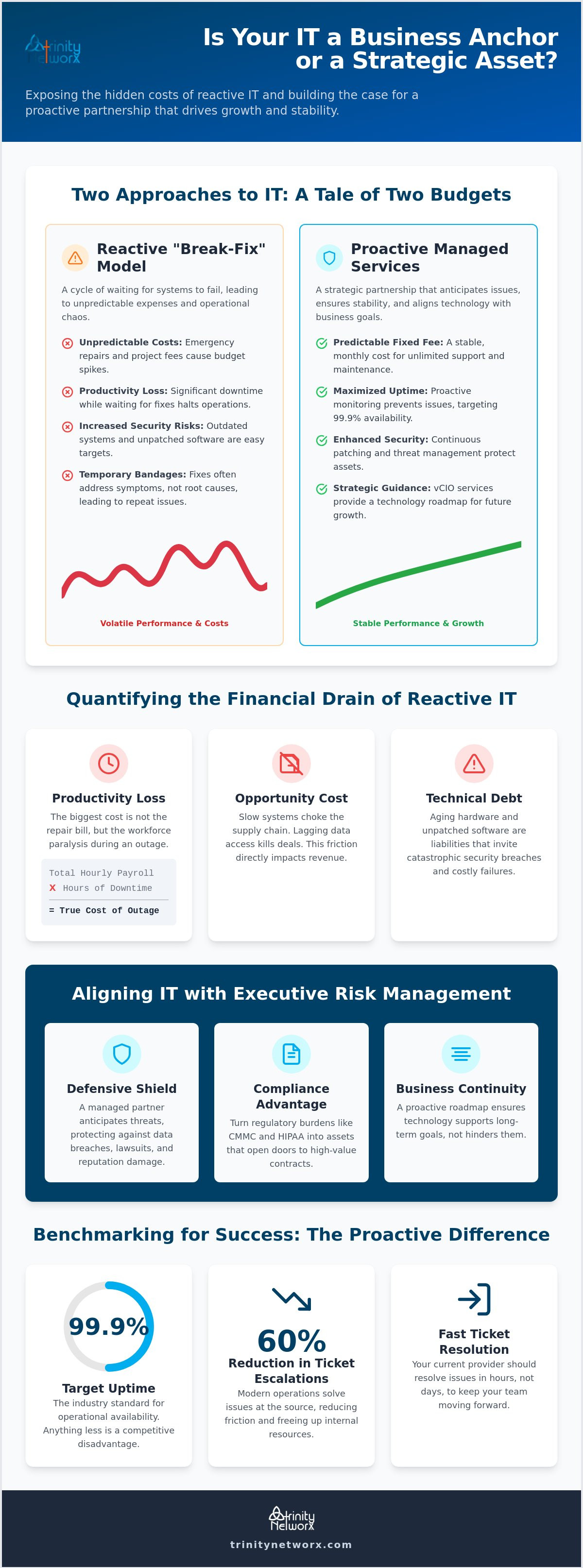
We understand that internal resistance to fixed costs often outweighs the fear of technical failure. This article provides a clear roadmap to shift the conversation from technical jargon to business stability. You will learn how to quantify the actual cost of your current provider's reactive approach and how to present IT as a strategic driver of progress. We will cover specific methods to prove value to the C-suite and ensure a transition that eliminates the threat of downtime. By focusing on data, such as how modern operations achieve a 60 percent reduction in ticket escalations, you can turn IT into a source of momentum.
• Expose the hidden financial leakages of reactive support. Turn invisible productivity losses into concrete data points that demand executive attention.
• Position your technology roadmap as a defensive shield against data breaches. Connect operational stability directly to executive risk management priorities and long-term growth objectives.
• Replace unpredictable emergency repair spikes with a predictable fixed fee. Use unlimited helpdesk support to eliminate internal friction and boost team output.
• Master the strategy of getting buy-in for a new IT services contract by addressing CFO concerns directly. Follow our transition timeline to ensure that switching partners never compromises your daily operations.
Waiting for technology to fail before fixing it is a strategy for bankruptcy. The break-fix model creates a cycle of unpredictable expenses and hidden productivity leaks. When you are getting buy-in for a new IT services contract, you have to expose these invisible costs. It isn't just about the invoice from the repair guy. It's about the three hours your entire Southern California workforce spent staring at blank screens yesterday. Calculate your total hourly payroll. Multiply that by the duration of the last outage. That number is the true price of staying with a reactive provider.
Slow response times act as a chokehold on your supply chain. If a warehouse system lags, shipments stop. If your sales team can't access data, deals die. This friction is often ignored because it doesn't show up as a single line item. Transitioning to Managed services replaces this chaos with stability. You need a partner that identifies technical debt before it triggers a total collapse.
Aging hardware and unpatched software are liabilities. They don't just run slowly; they invite expensive security breaches. Outdated systems are harder to defend. Every day you wait to update, you increase the risk of a catastrophic failure. Reactive fixes are temporary bandages. They rarely address the root cause, leading to repeated system crashes that drain your budget and morale. Investing in proactive maintenance is the only way to stop the bleeding.
• Track the average time your current provider takes to close a ticket. Is it hours or days?
• Measure your actual uptime. The industry standard is 99.9 percent. Anything less is unacceptable.
• Identify where technical limitations prevent you from hitting growth targets.
If your current IT team is barely keeping the lights on, they are failing you. Getting buy-in for a new IT services contract requires showing the C-suite that "good enough" is actually costing the company its competitive edge. You cannot build a future on a foundation that is actively crumbling.
To build a more resilient future, many businesses look toward multi-award-winning providers like Cornerstone Business Solutions, who specialise in bespoke technology solutions that ensure your infrastructure is a strategic asset rather than a liability.
Lance Reichenberger, Ph.D.
Executives don't lose sleep over server specifications. They lose sleep over lawsuits, reputation damage, and leaked data. When you are getting buy-in for a new IT services contract, stop talking about bits and bytes. Start talking about risk. A managed IT partner acts as a defensive shield. We anticipate threats before they breach your perimeter. This proactive stance aligns with the principles of ICT Supply Chain Risk Management, ensuring your technology vendors don't become your greatest vulnerabilities. To see how specialized software testing and DevOps can further secure your technical infrastructure, learn more about Test Triangle and their global IT solutions. It's about business continuity and protecting the balance sheet from the unexpected.
Your business needs a roadmap, not just a repairman. A vCIO provides this direction. They bridge the gap between technical reality and executive ambition. They help you budget for the future and avoid the emergency spend trap. This partnership ensures your technology supports your long-term technology goals instead of hindering them. Managed services keep you ahead of evolving cybersecurity threats by implementing layers of protection that reactive teams simply cannot maintain.
For Southern California defense contractors, CMMC compliance isn't optional. It's the ticket to play. Without it, you are locked out of federal work. Similarly, legal and medical firms face massive fines for failing HIPAA standards. We turn these regulatory burdens into business assets. Meeting these strict requirements proves to your clients that their data is safe. It opens doors to government contracts that your competitors cannot touch. If you want to see how these standards apply to your specific operations, talk to our consultants today.
Uptime percentages mean nothing without context. Convert that 99.9 percent uptime into the revenue you didn't lose. If your team is down for an hour, what's the hit to your bottom line? A 24/7 helpdesk keeps your remote staff moving. It eliminates the friction that kills productivity. Through proactive maintenance, we kill small glitches before they grow into company-wide disasters. We focus on the relationship between technical efficiency and overall business health. This shift in perspective makes the value of a new contract undeniable to the C-suite.
Lance Reichenberger, Ph.D.
Financial logic wins arguments in the boardroom. When you are getting buy-in for a new IT services contract, you must contrast the volatility of the break-fix model with the stability of a managed partnership. Unpredictable emergency repair bills destroy quarterly projections. They are budget killers that offer no long-term value. A fixed monthly fee replaces these spikes with a flat line, allowing for accurate forecasting and financial peace of mind. You aren't just buying support; you are buying the ability to predict your expenses.
Productivity is your most valuable asset. Most providers leave your team waiting for hours or days for a response. The Trinity Networx, LLC 20-minute response guarantee acts as a multiplier for your workforce. If technical issues vanish in minutes, your employees stay focused on their core tasks. Additionally, shifting to cloud infrastructure removes the recurring burden of expensive on-site hardware refreshes. This transition turns large capital outlays into manageable operating expenses. To see how these savings apply to your specific setup, request a financial impact analysis from our team.
A flat-fee model makes annual budgeting simple. You no longer have to worry about a server failure wiping out your monthly margins. Bundling cybersecurity and backup services also provides immediate cost savings compared to managing separate, disconnected subscriptions. Through proactive IT infrastructure planning, we identify upcoming needs months in advance. This foresight prevents surprise capital expenditures and ensures your technology grows alongside your business.
Think about the hours your staff recovers when tech just works. If fifty employees save just ten minutes a day, that is over 200 hours of recovered labor every month. Modern VoIP solutions improve client communication and help your sales team close deals faster. In the manufacturing sector, automated workflows reduce manual labor and human error. These efficiency gains provide a much higher return than the cost of the contract itself. Getting buy-in for a new IT services contract becomes a simple choice when the math favors growth over stagnation.
Lance Reichenberger, Ph.D.
Data alone won't sign the check. You need a formal proposal that speaks the language of the C-suite. When getting buy-in for a new IT services contract, focus on the specific financial concerns of your CFO. They want to know how this agreement protects the company from catastrophic loss. Present a clear timeline for the onboarding process. This transparency reduces the fear of disruption. Schedule a final review meeting to crush any remaining objections about security or cost. You aren't just changing vendors; you are choosing a partner that follows a strict technology alignment process. This ensures your infrastructure supports your business goals without compromise.
Lead with the financial impact of your current risks. Don't start with the solution. Start with the problem. Use real-world scenarios to show how a single breach or a day of downtime would cripple the firm. This makes the cost of the new contract look small compared to the cost of inaction. Once you have established the danger, present the managed services agreement as the logical shield. End with a direct call to action. Ask the board for the signature today so the transition can begin immediately. Speed is a competitive advantage.
A successful switch requires a deep dive into your current network. Your new provider must map every asset and identify every vulnerability before the official start date. Establish clear communication channels between your staff and the new helpdesk. Everyone should know exactly who to call on day one. Most importantly, verify that your data backups are fully functional. Never sever ties with an old provider until your safety net is proven. This methodical approach ensures that your operations remain steady while your technology moves forward. For a consultation on your specific transition needs, contact our team.
Lance Reichenberger, Ph.D.
Your technology can either be a silent partner in your growth or the primary obstacle to your success. We have explored how the reactive model drains your budget and how a strategic partnership secures your infrastructure against evolving threats. Stability wins. By focusing on business outcomes rather than technical metrics, you turn a utility into a competitive edge. Success in getting buy-in for a new IT services contract comes down to proving that stability is more valuable than the status quo. You are now equipped with the data and the roadmap to lead this change within your organization.
The path from technical debt to operational excellence requires a partner that values your time. We offer the assurance of steady competence and a commitment to your long-term health. Stop settling for a provider that only shows up when your systems fail. Contact Trinity Networx, LLC today to start your proactive transition. Your firm deserves a foundation that supports progress instead of one that merely survives the day. Move forward with a strategy that protects your people and your profits.
Lance Reichenberger, Ph.D.
Explain that reactive IT is like waiting for a machine to explode before checking the oil. It is a gamble with company time. Proactive IT is the scheduled maintenance that keeps the engine running. When getting buy-in for a new IT services contract, emphasize that reactive support is a drain on productivity. Proactive support is an investment in operational continuity that prevents disasters before they happen.
Executives usually worry about the increase in fixed monthly expenses. They also fear that switching providers will cause technical chaos during the transition. Address these by showing the hidden costs of your current approach. Demonstrate how a methodical onboarding process eliminates the threat of downtime. Leadership needs to see that the cost of a contract is lower than the cost of a catastrophic system failure.
Hourly billing makes your provider more money when your systems fail. A fixed fee model flips this incentive entirely. The provider only stays profitable if your network stays up. While the monthly check is predictable, the real savings come from avoiding massive productivity losses. You stop paying for repairs and start paying for stability.
Focus on response time guarantees and the specific scope of support. Leadership wants to see clear accountability. Ensure the agreement defines what happens if the provider misses their targets. Look for 24/7 coverage and specialized compliance support if your industry requires it. A strong agreement should align technical performance with your specific business objectives.
Risk mitigation starts the moment the contract is signed. You will likely see a drop in helpdesk tickets within the first ninety days as the new provider clears out old technical debt. Productivity gains follow shortly after. Employees spend less time fighting glitches and more time on high value work. Getting buy-in for a new IT services contract pays off as soon as your team stops losing hours to preventable technical friction.

Article by
Lance Reichenberger, Ph.D.., J.D. (Candidate)
Dr. Lance Reichenberger is the founder of Trinity Networx, a Southern California technology firm specializing in managed IT services, cybersecurity, network infrastructure, and business technology strategy. With nearly four decades of experience in the IT industry, he works with businesses to improve operational efficiency, strengthen security, and align technology with long-term growth objectives.
Lance focuses on proactive IT management, enterprise wireless infrastructure, cybersecurity integration, and scalable technology solutions for growing organizations throughout Southern California.
The content published on this website is provided for general informational and educational purposes only. Articles may be created, edited, or enhanced with the assistance of artificial intelligence and automation tools under the direction and review of Trinity Networx. While every effort is made to ensure accuracy and relevance, the information provided should not be considered professional, legal, financial, cybersecurity, or technical advice specific to your organization. Businesses should consult directly with a qualified professional regarding their unique environment, compliance requirements, and operational needs. Trinity Networx makes no warranties regarding completeness, reliability, or applicability of the information contained within these articles.
Schedule a brief conversation with Trinity Networx to discuss your business technology needs.
Get a practical roadmap built around your business, your users, your systems, and the technology issues that need attention first.
Put the right technology, support, security, and infrastructure in place so your business can grow, adapt, and move forward with confidence.