3281 E. Guasti Rd, STE 700, Ontario, CA 91761
1712 9th Ave SW, Watertown, SD 57201

Lance Reichenberger, Ph.D.
Contact the team at https://www.trinitynetworx.com/contact-us to secure your migration. Share this article: [Social Media Share Options]
Your server room is likely a ticking clock that drains your budget and limits your growth. Most owners realize that sticking with aging hardware invites a catastrophic failure, yet the dread of losing a week of productivity keeps them stuck. Migrating business operations to the cloud in Los Angeles is not about chasing a trend; it is about reclaiming your time and securing your data. You want a system that works while you sleep. You need a setup that lets your team work from a beach in Malibu or a home office in Pasadena without a single security hiccup. It is time to stop reacting to hardware failures and start dictating your own operational pace.
I have built this guide to help you navigate the 2026 CCPA cybersecurity audit mandates and the looming 2027 digital software taxes. We will look at how to select the right provider for your specific industry requirements. This article provides a clear, aggressive strategy to move your data without a second of downtime. We are going to replace your hardware headaches with a predictable, high-performance IT environment that drives your business forward. Expect a breakdown of the migration phases that protect your bottom line and empower your staff.
• Align your software with modern hosting to protect business continuity from the first day of your move.
• Select a hybrid or private model that matches your data privacy requirements while prioritizing operational speed.
• Execute migrating business operations to the cloud in Los Angeles by moving non-essential data first and scheduling heavy transfers during off-peak hours.
• Secure your remote team with mandatory multi-factor authentication and proactive managed cybersecurity services.
• Stop unexpected cost spikes by reviewing usage monthly and shifting to a 24/7 network monitoring model.
Cloud readiness is the alignment of your existing software with modern hosting environments to protect your bottom line from unexpected downtime. It is not a vague concept. It is a technical reality that determines whether your business thrives or halts during a transition. When migrating business operations to the cloud in Los Angeles, you cannot afford to guess about your current IT infrastructure. You need a cold, hard look at what is sitting in your server room right now. Hardware fails. It is a fact of life. If your servers are over four years old, the risk of a hardware-driven outage during a data transfer increases exponentially. Check the physical health of your on-premises hardware today. If you see thick dust or hear fans screaming for mercy, your physical stack is a liability that could derail your entire move.
Map out every application your staff uses to check for compatibility. We see many owners overlook small, industry-specific tools that haven't been updated in years. These legacy programs often struggle in a cloud computing environment without specific modifications. You must identify these outliers early. This prevents a situation where your team logs in on Monday morning only to find their most critical software is broken. We don't wait for things to break. We audit, we verify, and we move with precision.
Los Angeles businesses often face unique connectivity hurdles depending on their proximity to major data hubs. You must verify if your current office internet speeds can handle high-volume data transfers without choking your daily operations. A simple speed test isn't enough. You need to identify potential bottlenecks in your local area network before the move. Switches, old cabling, and outdated routers can all slow down the process. Plan for redundant connections now. Having a secondary fiber or high-speed wireless link ensures that a single local outage doesn't stop your migration in its tracks. Reliability is built on redundancy, not luck.
Categorize your software immediately. Some tools are ready for the cloud right now, while others need significant updates or even a total replacement. Document how your users access these programs. Do they need high-speed graphics? Do they rely on local print servers? Understanding these access patterns ensures the new environment supports your current workflows without frustration. For legacy software that cannot be easily updated, plan for specialized virtual desktop environments. This keeps your old tools functional while giving you the security and accessibility of the cloud. You want a stable environment, not a collection of workarounds.
Choosing a model is your first real fork in the road. You don't just pick a provider based on a logo. You pick it based on how much control you need over your data. Public clouds offer massive resources at a lower entry cost. Conversely, a private cloud gives you dedicated hardware that satisfies strict privacy rules for legal or medical firms. Many firms in Southern California find a hybrid model is the best compromise. It lets you keep sensitive records on-site while pushing daily tasks to the web. When you look at cloud computing services for business, you have to decide if you want to move fast or move smart. We don't believe in one-size-fits-all fixes.
Migrating business operations to the cloud in Los Angeles often forces a choice between speed and performance. If you are facing a lease expiration on your server room, you might not have time for a total redesign. In those cases, a 'lift and shift' approach gets you out of the physical building quickly. But if you want to actually lower your monthly bill, you should look at re-architecting your software. This means modifying your code to take full advantage of what a modern environment offers. It stops you from paying for virtual space you aren't using. This strategy requires more work upfront, but it prevents cloud bloat from eating your profits later. You want efficiency, not just a new bill.
This method moves your existing apps exactly as they are. It is the fastest path to the cloud. You avoid changing your operational logic; your staff doesn't need to relearn their tools on Monday morning. It's a solid win for SMBs that need immediate results. However, this isn't a permanent fix. It is the first phase of a larger plan. If you want a secure migration to the cloud, you must still apply strict access controls, even if the app itself remains the same. Don't let the simplicity of this move fool you into skipping security checks. Speed should never come at the cost of your data integrity.
Speed is good, but stability is better. Re-architecting involves changing how your software functions. It allows your apps to handle more users without slowing down. You reduce long-term costs by killing off old server structures that drain your budget. Before you jump in, review your current IT infrastructure to see if it can support these advanced moves. Moving to the cloud should make your business more agile, not just more expensive. If you aren't sure which path fits your specific growth plan, you should consult with a specialist to map out the right sequence for your hardware and software assets. We focus on results, not theories.
Stop thinking of your move as a single, high-stakes weekend event. That is how data gets lost and offices go dark. You need a methodical rollout instead. Migrating business operations to the cloud in Los Angeles requires a surgical touch to keep your staff productive while the heavy lifting happens behind the scenes. We don't believe in crossing our fingers and hoping for the best. We believe in controlled, predictable phases that protect your revenue.
Start by moving non-essential data. This lets you iron out any kinks in the connection without stopping a sale or a client call. A phased approach isolates risk to small, manageable segments rather than risking the entire corporate data set in a single, high-stakes event. You should also maintain your local backup until the new environment is fully verified. Migrating business operations to the cloud in Los Angeles shouldn't feel like a leap of faith. We don't pull the plug on the old server until we know the new one is bulletproof.
Timing is everything. Schedule your heaviest data transfers during off-peak hours. In a city like Los Angeles, where business never truly stops, you have to find those windows where bandwidth is free. This protects your office productivity during the day. When you select a cloud migration strategy, the execution phase is where the plan meets reality. You want zero surprises and zero downtime.
Move your email and document storage first. These are low-risk wins that build team confidence in the new system. Only move your core business applications after you have tested the new network speed under a real load. Your it-management team must be standing by. They need to be ready to support users the second they log in to the new environment. We don't leave people guessing about where their files went. Clear communication keeps your staff calm and focused on their own tasks.
Never assume the transfer was perfect. Run checksums to ensure no data was corrupted during the move. This is a non-negotiable step for any professional migration. You must test user permissions immediately. This prevents unauthorized access and stops workflow blocks before they frustrate your staff. We provide a helpdesk response in under 20 minutes for any migration-related hiccups. Precision matters. If a user can't find a file or a folder, we fix it fast. Your business health depends on this level of responsiveness and technical accuracy.
Security is not a checkbox. It is a strategic driver of progress. You can't simply move your files and expect them to stay safe without an active defense. Statistics show that 94% of businesses report significant online security improvements after moving, but that only happens with the right setup. We implement multi-layered managed cybersecurity services from the start. This proactive stance stops threats before they reach your network. We don't play catch-up with hackers. We shut the door before they arrive.
Migrating business operations to the cloud in Los Angeles requires a deep understanding of local laws. California leads the nation in data privacy. The CCPA updates that took effect on January 1, 2026, now mandate privacy risk assessments for any business processing high-risk data. This isn't optional. You must also enforce multi-factor authentication for every remote user in your organization. Encrypt all data while it moves and while it sits in the cloud. If your data isn't encrypted at rest, you are leaving your business exposed to massive fines and reputational damage. We audit your setup against these local and federal standards to ensure you are bulletproof.
Southern California is a massive hub for defense and healthcare. If your LA business handles defense contracts, you must be ready for CMMC. Medical or legal firms moving sensitive client files have to maintain strict HIPAA compliance. We don't just hope you're compliant. We automate the reporting process. This saves your team hundreds of hours during annual audits. Your it-management plan should treat compliance as a foundation, not a burden. We help you navigate these complex rules so you can focus on your actual work. We replace confusion with technical certainty.
Control who sees your data. Use role-based access to ensure your marketing team isn't looking at payroll files. This limits the damage if an account is ever compromised. You also need to monitor for unusual login activity. If a login attempt comes from outside of Southern California at 3:00 AM, our systems flag it instantly. Revoke access immediately when an employee leaves the company. Don't let a former staff member be the weak link in your it-infrastructure. If you want to verify your current security posture, talk to our compliance experts today. We provide the professional assurance you need to operate with confidence.
Lance Reichenberger, Ph.D.
Contact the team at https://www.trinitynetworx.com/contact-us for expert support. Share this article: [Social Media Share Options]
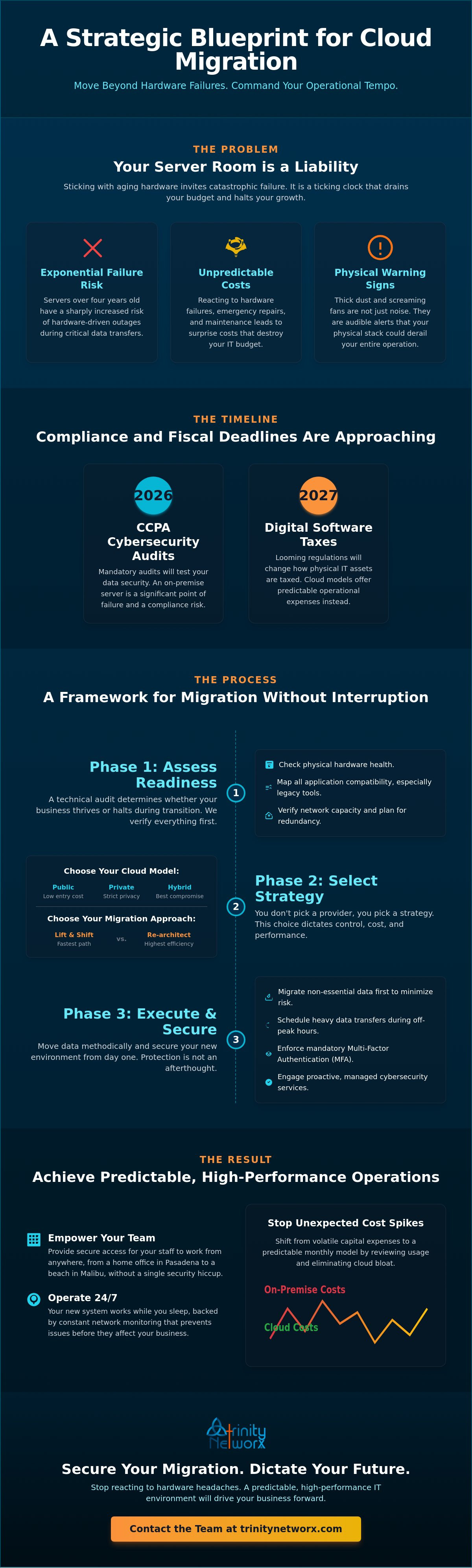
The move is done. Your hardware is gone. But your responsibility to your data has just increased. You must transition from reactive repairs to a model based on proactive 24/7 network monitoring. Waiting for a crash is a strategy for the past. Migrating business operations to the cloud in Los Angeles creates an opportunity to dictate your own uptime. We watch your traffic patterns every second of every day. This catches threats before they breach your perimeter. It also ensures your speed stays high. Regular it-optimization keeps your environment fast and lean. We cut the fat so your team can move with more agility.
Cloud bills can spiral without warning. Research shows that 84% of organizations report that managing cloud spend is their biggest headache. You need a strict approach. Review your usage every month. If you aren't using a resource, kill it. Don't pay for virtual space that sits empty. This is especially vital as California prepares to apply sales tax to SaaS and digital software on January 1, 2027. Every dollar matters. We scale your storage up or down based on what you actually need today. Your staff must also be trained on new cloud workflows. Efficiency depends on people knowing their tools. If they struggle with the new system, your productivity will tank regardless of how fast your servers are.
Track your application response times religiously. If an app lags, find out why immediately. You should establish a baseline for normal network traffic. This makes it easy to spot a hacker trying to move data out of your network. Your IT partner must provide a rapid response guarantee for any downtime. We don't accept long outages as a cost of doing business. We treat them as a failure to be avoided through constant vigilance and technical precision. If your cloud isn't faster than your old server room, your setup needs a professional review.
Delete unused resources that drive up your monthly hosting fees. Digital clutter is expensive. Scale your storage based on actual business demand, not on a guess you made three months ago. This keeps your budget predictable. You should also invest in vCIO services. This aligns your cloud spending with your long-term growth goals. We help you stay lean and fast by ensuring you only pay for what you use. Avoid the trap of over-provisioning. In the 2026 business landscape, technical efficiency is the primary driver of your bottom line.
Lance Reichenberger, Ph.D.
Contact the team at https://www.trinitynetworx.com/contact-us. Share this article: [Social Media Share Options]
Success in the cloud isn't a lucky accident. It is the result of a hard audit, a precise strategy, and a refusal to settle for hardware that holds you back. You now have the blueprint for migrating business operations to the cloud in Los Angeles without the usual chaos. We have covered everything from assessing your local network limits to locking down CMMC and HIPAA compliance. Your next move determines whether your team remains tethered to a server room or gains the freedom to work from anywhere with absolute security. Don't let fear of downtime keep you in a reactive state. It is time to act.
We provide the proactive cybersecurity stack and technical precision needed to make this shift permanent. Our 24/7 helpdesk maintains a sub-20 minute response time. We don't leave you hanging when a file goes missing or a login fails. We fix it before it impacts your day. Secure your business future by contacting our Los Angeles cloud experts today. Your business deserves a stable, predictable IT environment that actually supports your growth. Let's build it together.
Lance Reichenberger, Ph.D.
Contact the team at https://www.trinitynetworx.com/contact-us to start your move. Share this article: [Social Media Share Options]
Cloud migration is secure when you implement zero-trust architecture and multi-layered encryption. For firms handling defense or medical data, we align your environment with CMMC and HIPAA standards from day one. We don't just move files. We build a digital perimeter. This ensures your data remains compliant with California's strict privacy mandates while staying accessible to your authorized team.
A typical transition takes between four and twelve weeks depending on your data volume. Migrating business operations to the cloud in Los Angeles is a phased process, not a weekend sprint. We move low-risk data first to test the connection. This methodical pace prevents the errors that occur when IT teams rush a deployment without proper testing.
Most of your current hardware will work perfectly. The cloud handles the heavy processing, so your local desktops essentially become windows into a high-powered environment. This often extends the life of your existing laptops. You save money on hardware refreshes while your staff enjoys faster application speeds without needing expensive local upgrades.
Your operations don't stop if the office internet fails. Because your data lives in a secure data center, your staff can simply relocate to a home office or use a mobile hotspot to continue working. We also recommend installing a secondary, redundant internet line. This ensures your headquarters stays connected even during a local provider outage or a physical line break.
You can absolutely move in stages. This hybrid approach allows you to keep legacy software on local hardware while pushing email and collaboration tools to the web. It is a smart way to manage risk for complex operations. We help you identify which workloads are ready for the jump and which should stay on the ground for now.
Your security posture improves through 24/7 monitoring and automated patching. You move away from the reactive model where you only notice a problem after a crash. Enterprise-grade firewalls and intrusion detection systems now protect your small business. We replace manual updates with a proactive defense that hunts for threats before they can impact your files.
Migration costs depend on your specific server count and the complexity of your applications. You stop paying for expensive physical server replacements every few years. Instead, you move to a predictable monthly operating expense. This makes your IT budget stable and easier to manage as your business grows without the shock of sudden hardware failure costs.
A local partner understands the Los Angeles infrastructure and regional compliance hurdles. We know the local fiber loops and can provide on-site support if your physical cabling needs attention during the move. You get a strategic partner who is in your time zone. We understand the fast-paced nature of the SoCal market and respond with the urgency your business demands.

Article by
Lance Reichenberger, Ph.D.., J.D. (Candidate)
Dr. Lance Reichenberger is the founder of Trinity Networx, a Southern California technology firm specializing in managed IT services, cybersecurity, network infrastructure, and business technology strategy. With nearly four decades of experience in the IT industry, he works with businesses to improve operational efficiency, strengthen security, and align technology with long-term growth objectives.
Lance focuses on proactive IT management, enterprise wireless infrastructure, cybersecurity integration, and scalable technology solutions for growing organizations throughout Southern California.
The content published on this website is provided for general informational and educational purposes only. Articles may be created, edited, or enhanced with the assistance of artificial intelligence and automation tools under the direction and review of Trinity Networx. While every effort is made to ensure accuracy and relevance, the information provided should not be considered professional, legal, financial, cybersecurity, or technical advice specific to your organization. Businesses should consult directly with a qualified professional regarding their unique environment, compliance requirements, and operational needs. Trinity Networx makes no warranties regarding completeness, reliability, or applicability of the information contained within these articles.
Schedule a brief conversation with Trinity Networx to discuss your business technology needs.
Get a practical roadmap built around your business, your users, your systems, and the technology issues that need attention first.
Put the right technology, support, security, and infrastructure in place so your business can grow, adapt, and move forward with confidence.