3281 E. Guasti Rd, STE 700, Ontario, CA 91761
1712 9th Ave SW, Watertown, SD 57201
The IT option with the lower upfront bill isn’t automatically the better fit. In the operational expense vs capital expense for IT decision, CapEx generally means acquiring or improving an asset expected to provide benefits beyond the current period, with its cost recognized over time; OpEx covers ongoing costs such as subscriptions and support, expensed as incurred. For businesses in California, Nevada, Arizona, and Utah, the choice can affect cash flow, budgeting, and financial statements.
A recurring service is usually budgeted as an operating cost, while a purchase may provide value beyond its first year. The right approach depends on what the spending buys and how the business will use it. This guide explains the accounting and practical differences, compares common IT examples, and shows how to weigh ownership, recurring costs, flexibility, and long-term operating needs.
• Compare the full cost over the technology’s useful life, not just the upfront purchase or recurring bill.
• Match the spending model to your cash flow, maintenance needs, and how much control you want over IT assets.
• Understand how capitalization and depreciation affect financial reporting before committing to a long-term technology purchase.
• Use managed IT or co-managed support to align technology decisions with your business operations and security needs.
Neither approach suits every IT purchase. The operational expense vs capital expense for IT choice depends on the asset’s useful life, cash-flow needs, maintenance demands, and financial-statement treatment.
CapEx funds long-term assets, such as production servers; OpEx covers recurring services. The operational expense vs capital expense for IT comparison matters when a manufacturer weighs an upfront investment against ongoing budget commitments. Consider how long equipment will support operations and whether recurring access better fits changing production needs.
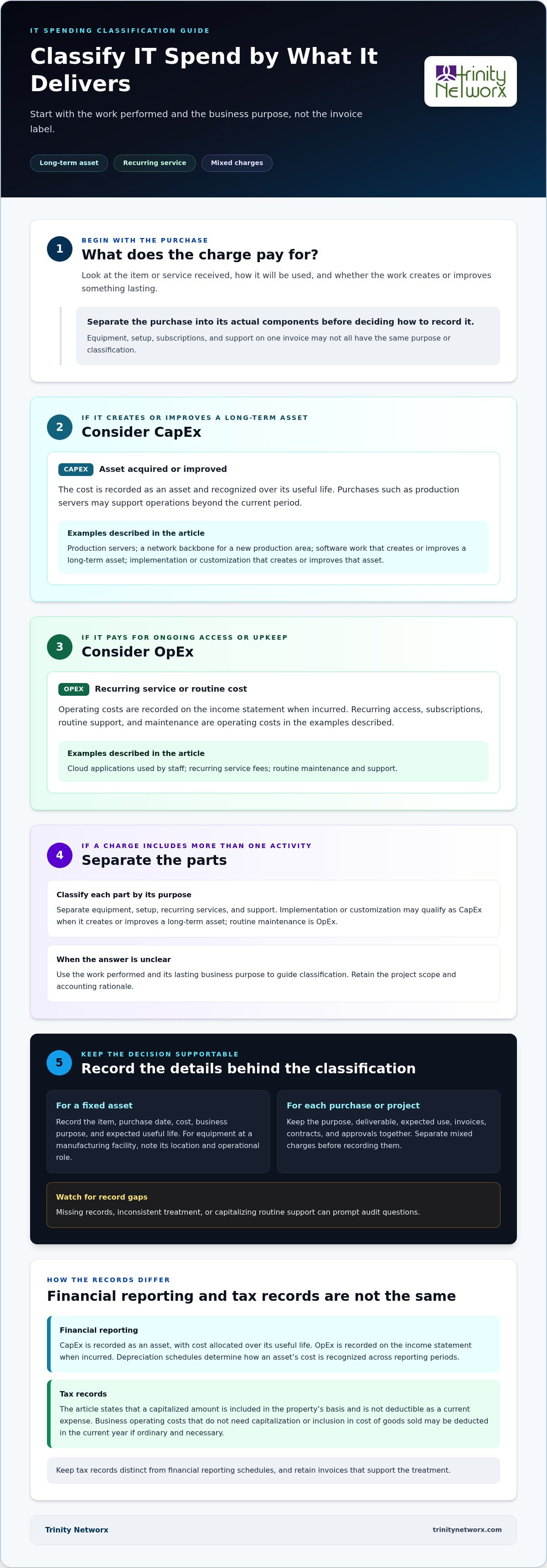
CapEx is recorded as an asset on the balance sheet, and purchases of property, plant, and equipment generally appear in investing activities on the cash flow statement. OpEx is recorded on the income statement when incurred. A common CapEx calculation uses the change in property, plant, and equipment between periods plus current-period depreciation. Keep cost of goods sold distinct: it is deducted as goods are sold.
Technology and software work may qualify as CapEx when it creates or improves a long-term asset. Under GAAP, capitalized internal-use software is recorded as an asset and amortized over its useful life. Classification depends on the work performed and its lasting business purpose. Retain the project scope and accounting rationale to support the treatment.
Implementation or customization that creates or improves a long-term asset may be capitalized; routine maintenance is an operating cost. Separate bundled charges by activity. For each purchase, document its purpose, deliverable, expected use, and classification. Keep invoices, contracts, and approvals together. Missing records, inconsistent treatment, or capitalizing routine support can prompt audit questions.
The practical challenge is keeping financial reporting and tax records aligned without treating them as identical. For IT assets, retain purchase details, accounting decisions, and tax records together so each treatment has a clear basis.
A fixed-asset record should identify the item, purchase date, cost, business purpose, and expected useful life. These details help finance teams track assets as they move between departments or production sites. For a server installed at a manufacturing facility, recording its location and operational role also helps distinguish the equipment from related service charges and later support work.
Depreciation schedules determine how an asset’s cost is recognized across reporting periods, while immediate expensing places an eligible cost in the current period. Keep the accounting method and supporting rationale with the asset record. When a purchase includes equipment, setup, and recurring services, separate those components before recording them; bundled entries can obscure the appropriate treatment for each part.
For tax purposes, the Internal Revenue Service says a capitalized amount is not deductible as a current expense and must be included in the property’s basis. Business operating costs that do not need capitalization or inclusion in cost of goods sold may be deducted in the current year if ordinary and necessary. Keep tax records distinct from financial reporting schedules, and retain invoices that support the treatment. For help planning technology spending, discuss your IT budget with Trinity Networx, LLC.
An operational expense vs capital expense for IT review should start with what the business receives, not the invoice label. Under U.S. accounting standards, a purchase that creates or improves a long-lived asset may be CapEx; recurring access, routine support, and upkeep are usually OpEx. The expected benefit and work performed guide classification.
Timing shapes the budget. Capital purchases often align with projects or replacement cycles, while operating costs recur as the business runs. A manufacturer might invest in a network backbone for a new production area, then pay recurring fees for cloud applications used by staff. The first supports lasting infrastructure; the second pays for continuing access.
Accounting treatment also changes how results appear. CapEx is recorded as an asset, with its cost allocated over its useful life. OpEx is recorded on the income statement when incurred. This affects reported profit and the timing of cash outflows, so finance teams should compare full ownership and service costs across relevant periods.
To assess operational expense vs capital expense for IT, break each project into the item purchased, services received, and ongoing charges. Then record the business purpose and expected use of each part.
• Classify lasting equipment or improvements by the asset they create or enhance.
• Record subscriptions and routine support as recurring operating costs.
• Separate mixed invoices so each charge reflects its actual purpose.
These practices help keep accounting records consistent as technology needs change. For a manufacturing operation, periodic reviews can also show whether owned equipment or recurring services better fit production plans and cash flow.
Trinity Networx, LLC helps businesses align IT support with day-to-day operational demands. For manufacturers balancing production technology with facility or construction projects, gaps in planning, security, or data protection can disrupt work. Trinity Networx provides construction-focused IT planning to connect project needs with practical technology support.
Managed IT Services, Co-Managed IT, Cybersecurity Solutions, and Data Backup & Recovery help businesses manage changing technology demands. These services can support internal IT teams that need additional capacity and help coordinate production systems, project work, and business data.
Share your operational priorities with Trinity Networx, LLC. Contact the team to discuss your business needs.
In your next budget review, connect each planned technology decision with its business purpose, useful life, cash-flow effect, and operational demands. This gives finance and IT a shared basis for weighing ownership against recurring services while keeping production priorities in view. The strongest plan is the one that fits how the business needs to operate.
A practical operational expense vs capital expense for IT plan also leaves room to revisit assumptions as equipment ages, software needs shift, and security priorities change. Trinity Networx provides Managed IT Services, Cybersecurity Solutions, and Data Backup & Recovery to support business technology needs. Align finance, operations, and IT before a spending decision becomes difficult to change.
Contact Trinity Networx to discuss your IT plans. A clear next step can help your team move forward with confidence.
A manufacturing company’s purchase of a production-line control server is an example of CapEx if it will support operations over multiple periods. The company records a qualifying purchase as an asset, then accounts for its cost over its useful life. Installation work may need separate assessment if an invoice combines equipment, setup, and ongoing support.
A company’s recurring cloud storage subscription is an example of OpEx. The charge pays for ongoing access during each billing period, rather than ownership of a lasting asset. Other examples include monthly software access, routine technical support, and regular equipment servicing. Separate recurring charges from purchases so the accounting records show what each payment covers.
CapEx can give a business direct control over equipment and support long-term operations, while tax depreciation may spread deductions across periods. The tradeoff is a larger upfront investment and responsibility for upkeep, repairs, and eventual replacement. For example, owning a factory network system may suit steady production needs, but it also creates asset-management work as equipment ages.
Operating expenses include recurring costs tied to daily business activity, such as payroll, rent, utilities, routine repairs, and recurring software or support charges. A factory’s monthly internet service and regular maintenance for existing workstations are practical examples. Classify each expense by its business purpose and the service or benefit received during the accounting period.
Capital expenditures include purchases or improvements that create or extend the use of long-term assets. Examples include production machinery, computers, network equipment, and qualifying technology upgrades. A manufacturer adding a permanent network system to a new facility may treat the equipment as a capital investment. Distinguish the lasting asset from recurring service charges tied to its operation.

Article by
Lance Reichenberger, Ph.D.., J.D. (Candidate)
Dr. Lance Reichenberger is the founder of Trinity Networx, a Southern California technology firm specializing in managed IT services, cybersecurity, network infrastructure, and business technology strategy. With nearly four decades of experience in the IT industry, he works with businesses to improve operational efficiency, strengthen security, and align technology with long-term growth objectives.
Lance focuses on proactive IT management, enterprise wireless infrastructure, cybersecurity integration, and scalable technology solutions for growing organizations throughout Southern California.
The content published on this website is provided for general informational and educational purposes only. Articles may be created, edited, or enhanced with the assistance of artificial intelligence and automation tools under the direction and review of Trinity Networx. While every effort is made to ensure accuracy and relevance, the information provided should not be considered professional, legal, financial, cybersecurity, or technical advice specific to your organization. Businesses should consult directly with a qualified professional regarding their unique environment, compliance requirements, and operational needs. Trinity Networx makes no warranties regarding completeness, reliability, or applicability of the information contained within these articles.
Schedule a brief conversation with Trinity Networx to discuss your business technology needs.
Get a practical roadmap built around your business, your users, your systems, and the technology issues that need attention first.
Put the right technology, support, security, and infrastructure in place so your business can grow, adapt, and move forward with confidence.