3281 E. Guasti Rd, STE 700, Ontario, CA 91761
1712 9th Ave SW, Watertown, SD 57201
Imagine a foreman on a loud job site receiving a text that looks like an urgent change order from your main office. He taps the link on his personal phone; within minutes, your project's financial data is in the hands of a criminal halfway across the globe. Cybercrime is projected to cost the world $10.5 trillion annually by 2025, and construction firms are prime targets for these sophisticated social engineering tactics. Implementing a rigorous phishing attack simulation and training for employees is no longer a luxury. It is a critical project requirement to keep your operations moving.
You already know that your field crews and office staff are under constant fire from fake invoices and smishing attempts that bypass traditional filters. It is frustrating to watch your profits vanish because of a single clicked link. This field guide provides the strategy to stop wire fraud and credential theft before they halt your progress. We will show you how to build a culture of security where every team member acts as a human firewall. You will learn to meet NIST 800-171 requirements and secure your project data without the typical administrative headache.
• Identify why standard security modules fail construction crews by ignoring the reality of fake change orders and fraudulent vendor updates.
• Deploy a phishing attack simulation and training for employees that uses project-specific scenarios like material delivery notices to ensure maximum field engagement.
• Run a silent baseline simulation to pinpoint vulnerabilities across your office and site staff before announcing your security initiative.
• Secure your project timeline by integrating staff training with 24/7 monitoring and proactive maintenance for immediate remediation after a suspicious click.
Generic security modules often focus on corporate office scenarios. Fake handbook updates. Suspicious HR requests. These templates fail on a job site. A site superintendent juggling three subcontractors doesn't have time for irrelevant simulations. Simulated phishing for the construction sector must reflect the chaos of active projects. If the training doesn't look like a real material delivery notice or an urgent change order, your team will ignore it. This disconnect leaves your firm vulnerable.
Attackers are getting smarter. They use smishing to target field workers on personal devices where your corporate firewall can't help. One tapped link on a mobile app can grant access to your entire network. This vulnerability can lead to a project-wide ransomware event that locks your BIM models and halts production. Effective phishing attack simulation and training for employees must account for these mobile-first realities. You need a defense that works in the dirt, not just the cubicle.
Criminals monitor your project timelines to strike when the pressure is highest. They send spoofed emails that look exactly like a trusted project manager requesting a bank account update for a major subcontractor. In a $10 million commercial build, business email compromise occurs when an attacker impersonates a known contact to redirect high-value payments into a fraudulent account. These attacks bypass office skepticism because they feel like standard project workflow. Protecting your profits requires cybersecurity and antivirus protocols that go beyond basic software.
Meeting a contract's compliance requirements doesn't mean your data is safe. Standard training is often a boring exercise that employees click through as fast as possible. Construction teams need practical skills to verify identity in a fast-paced environment. If your phishing attack simulation and training for employees doesn't teach a foreman how to spot a fake text during a concrete pour, it has failed. Real security comes from a culture where reporting a suspicious message is second nature, not just a box to check once a year. Protect your project timeline by contacting the team at https://www.trinitynetworx.com/contact-us to secure your site today.
Don't start with a company-wide announcement. That's a mistake. Instead, establish a baseline by running a silent simulation. You need to see how many people click before they've been warned. This data reveals your actual risk level. Once you have these numbers, you can launch a phishing awareness training program that addresses the specific gaps in your crew's knowledge. Effective phishing attack simulation and training for employees works best when it's grounded in reality, not theory.
Design your simulations to mimic actual project communications. Use material delivery notices, safety updates, or weather alerts. For field staff, focus on smishing. These workers rely on text messages for site coordination, making them prime targets for malicious links sent via SMS. If a worker fails a simulation, provide immediate, non-shaming feedback. A quick "teachable moment" on their screen is far more effective than a disciplinary meeting. It builds trust rather than resentment.
Your team uses specific project management software every day. Your simulations should too. Create fake notifications that look exactly like your internal tools. Attackers love to exploit the urgency of project deadlines. They know a foreman is more likely to click a link if they think a concrete pour is delayed. Integrating these scenarios into your cybersecurity and antivirus Ontario strategy ensures your defense is as fast-paced as your job site. If you aren't sure where to start, talk to an expert to build a custom plan.
Click rates only tell half the story. You need to track the reporting rate. How many employees used the proper channel to flag the threat? A high reporting rate indicates a culture of security. Analyze how quickly your team identifies a threat during peak project hours. If your crew can spot a fake invoice during a hectic Monday morning, your training is working. Success means zero successful breaches, not just low click percentages.
Phishing defense isn't a standalone project. It's a layer that requires proactive maintenance and constant monitoring. You can't expect a single training session to stop every threat. Human error is inevitable. When a click happens, you need a local Southern California team that responds in minutes. Our 100 percent in-house staff understands that project delays cost thousands of dollars per hour. We provide the technical backstop you need. This includes multi-factor authentication and endpoint protection that catches what the human eye misses. Integrating a phishing attack simulation and training for employees into this stack creates a unified defense.
Managed IT services provide a steady rhythm of security. We conduct regular quarterly reviews to align your security training with upcoming project phases. If you're moving from pre-construction to active mobilization, your risk profile changes. Your phishing attack simulation and training for employees should change too. This proactive approach ensures that your defense evolves alongside your project timeline. We keep your project moving.
Security awareness training belongs in your flat-fee managed service plan. It ensures consistency across your entire project team. You shouldn't have to worry about fluctuating costs when adding new subcontractors to your network. If a sophisticated AI-generated attack slips through, data backups and disaster recovery serve as your ultimate fail-safe. We ensure your data is recoverable within our 60-minute response guarantee, keeping your job site operational. No excuses.
Technology is only half the battle. Encourage your field crews to verify any unusual financial request with a quick phone call. A 30-second conversation can prevent a million-dollar wire fraud event. Trinity Networx, LLC acts as your internal IT department. We simplify these complex security protocols so your team can focus on building. We handle the technical heavy lifting while you maintain your project schedule. Secure your profits and your project data by contacting our team at https://www.trinitynetworx.com/contact-us today.
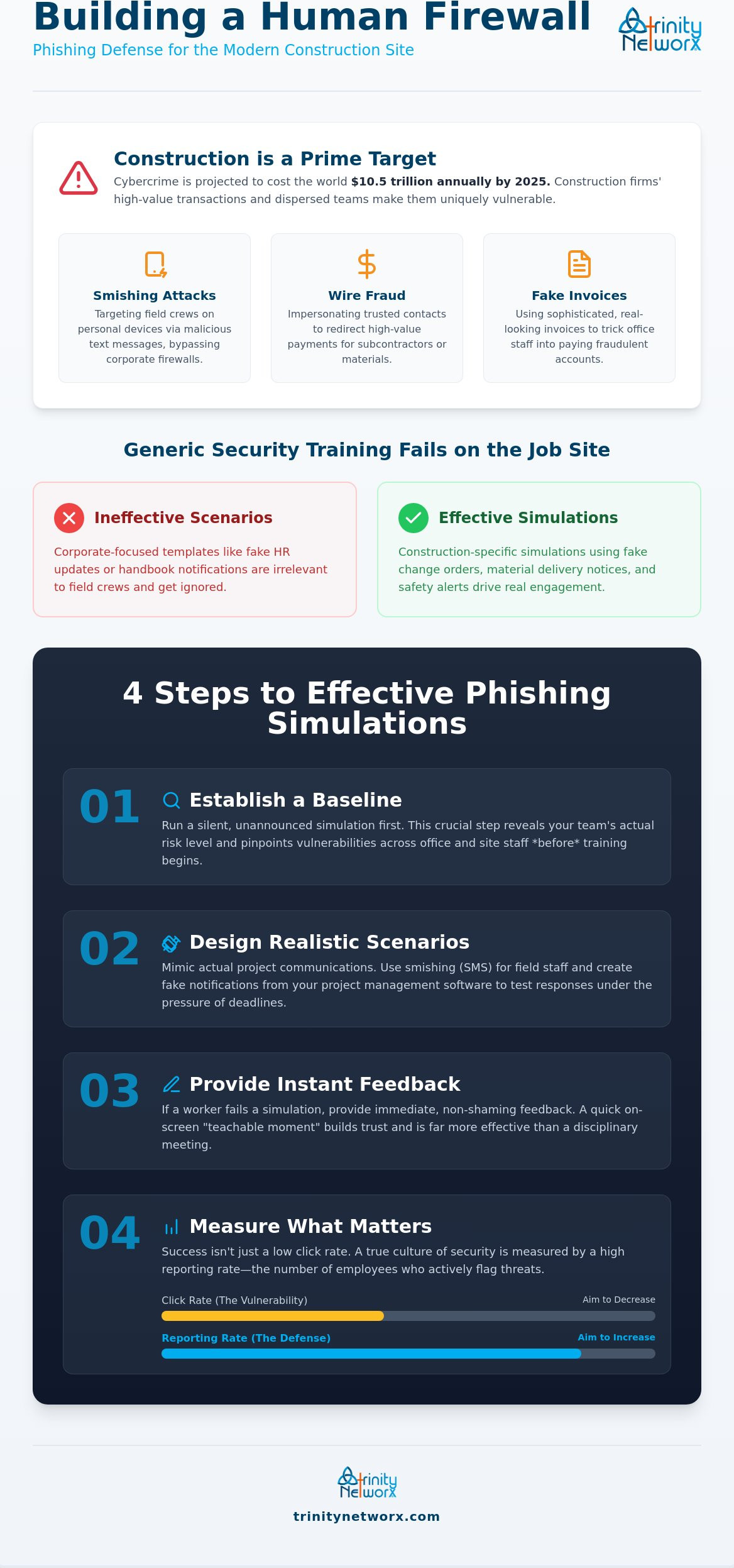
Construction is a high-stakes industry where one wrong click can stall a multi-million dollar build. Generic training won't cut it. You need a program that understands the difference between a corporate email and a site-specific smishing attempt. Implementing a dedicated phishing attack simulation and training for employees is the only way to turn your crew into a proactive line of defense. By using scenarios that mirror your actual daily workflows, you reduce the risk of wire fraud and ransomware that targets project-critical data like engineering specifications.
Security shouldn't be a distraction from your core work. Partnering with a team that offers an under 20-minute response time guarantee ensures that any suspicious activity is neutralized before it spreads. Our 100% local Southern California experts manage the technical heavy lifting under flat-fee pricing with no hidden charges. This allows you to forecast costs accurately while maintaining a secure project site. Solve your IT nightmares and secure your crew today. Your team is ready to become your strongest asset in the fight against cybercrime.
Construction firms should run phishing simulations at least once a month to keep security front of mind for every crew member. Research indicates that knowledge retention from one-time training sessions drops by approximately 70 percent within 30 days without ongoing reinforcement. Monthly tests keep your team sharp against evolving threats. While quarterly simulations are the bare minimum for some contracts, high-turnover job sites benefit from more frequent cycles to catch new hires early.
Yes, phishing attack simulation and training for employees is a vital component of meeting federal data protection standards. Even though the Department of War suspended CMMC Phase II requirements on July 13, 2026, contractors remain obligated to protect federal data under DFARS clause 252.204-7012. Implementing these simulations helps you document a proactive security posture. It proves to auditors that your firm actively defends controlled unclassified information against social engineering attempts that target your project supply chain.
The worker must report the incident to your IT department or project manager immediately. Speed is the only priority here. They should disconnect their device from the job site Wi-Fi or cellular network to prevent any potential malware from spreading to other project systems. We encourage a no-shame reporting culture because hiding a mistake gives attackers more time to encrypt your data. Rapid reporting allows our team to start remediation within minutes to protect your timeline.
Smishing is a significant threat to Southern California construction firms because field crews rely almost exclusively on mobile devices for site coordination. Attackers send text messages that look like urgent safety alerts or material delivery updates to trick workers into tapping malicious links. These messages bypass traditional email filters and often have higher success rates for criminals. Effective phishing attack simulation and training for employees must include SMS-based scenarios to prepare your team for these specific, mobile-first attacks.

Article by
Lance Reichenberger, Ph.D.., J.D. (Candidate)
Dr. Lance Reichenberger is the founder of Trinity Networx, a Southern California technology firm specializing in managed IT services, cybersecurity, network infrastructure, and business technology strategy. With nearly four decades of experience in the IT industry, he works with businesses to improve operational efficiency, strengthen security, and align technology with long-term growth objectives.
Lance focuses on proactive IT management, enterprise wireless infrastructure, cybersecurity integration, and scalable technology solutions for growing organizations throughout Southern California.
The content published on this website is provided for general informational and educational purposes only. Articles may be created, edited, or enhanced with the assistance of artificial intelligence and automation tools under the direction and review of Trinity Networx. While every effort is made to ensure accuracy and relevance, the information provided should not be considered professional, legal, financial, cybersecurity, or technical advice specific to your organization. Businesses should consult directly with a qualified professional regarding their unique environment, compliance requirements, and operational needs. Trinity Networx makes no warranties regarding completeness, reliability, or applicability of the information contained within these articles.
Schedule a brief conversation with Trinity Networx to discuss your business technology needs.
Get a practical roadmap built around your business, your users, your systems, and the technology issues that need attention first.
Put the right technology, support, security, and infrastructure in place so your business can grow, adapt, and move forward with confidence.