3281 E. Guasti Rd, STE 700, Ontario, CA 91761
1712 9th Ave SW, Watertown, SD 57201

The standard move to a massive public cloud might be the very thing slowing your project delivery to a crawl. You've felt the sting of field crews idling because a complex CAD file won't sync over a shared connection. It's an expensive delay. It eats into your margins while old office servers hum loudly in the background. Deciding on a private vs public cloud for my business is no longer a luxury for the IT department to manage. It is a critical decision for your firm’s survival. This article reveals the exact infrastructure required to protect your project bids from the $4.8 million average cost of a data breach. You will learn how to stabilize your monthly IT spend and ensure your crews have instant access to data. We break down the performance metrics and security controls that keep your firm moving forward while competitors stay stuck in the digital mud.
• Compare the differences between shared public resources and dedicated hardware to find the right private vs public cloud for my business.
• Secure your most sensitive project bids and client contracts within an isolated environment that ensures total data sovereignty.
• Audit your existing office hardware and team size to pinpoint the exact moment a cloud migration becomes more profitable than maintaining old servers.
• Eliminate field crew downtime by matching your cloud infrastructure to the high demands of CAD files and job site connectivity.
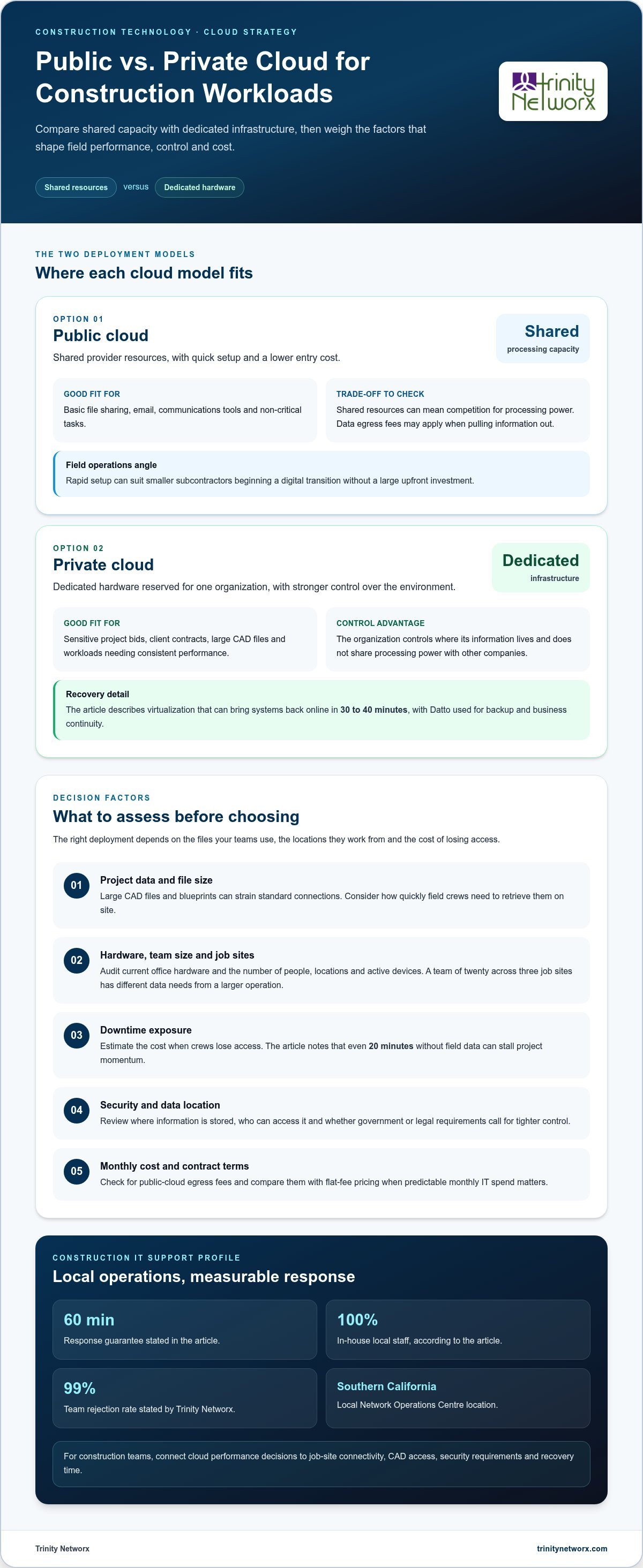
Understanding the technical divide between public and private infrastructure is the first step toward field efficiency. A public cloud relies on shared resources from massive providers like Microsoft or Amazon. You are essentially renting space in a digital apartment complex. Conversely, a private cloud involves dedicated hardware reserved for a single organization. This ensures total isolation. When evaluating private vs public cloud for my business, performance remains the primary driver. Construction firms handle massive project files that choke standard connections. Stop waiting for files to load. The deployment model you choose dictates how fast your team pulls blueprints on a tablet at a remote job site. High latency kills productivity. It halts progress. Dedicated environments often provide the raw power needed to move heavy data without the noisy neighbor effect of shared servers. This foundational shift in cloud computing allows for tighter control over bandwidth and latency. It ensures your CAD files aren't competing with a thousand other businesses for processing power.
Public options excel when speed of setup is the priority. These platforms allow for the rapid deployment of communication tools like Business VoIP to keep field crews connected instantly. For small subcontractors making their first digital transition, the low entry cost is a major benefit. It removes the need for large upfront capital. You can get started with basic file sharing and email without heavy investment. To see how these tools fit your specific job site, explore cloud solutions in Ontario for a localized implementation strategy. This approach works well for non-critical tasks that don't require high-speed data transfers. We provide rapid server spin up in 30 to 40 minutes to keep your projects on track. If your current setup is failing, contact our team at https://www.trinitynetworx.com/contact-us.
Private environments serve as a digital fortress for your most sensitive project bids and client contracts. When weighing a private vs public cloud for my business, the issue of data sovereignty often takes center stage. You maintain 100 percent control over where your information lives. There is no ambiguity. Public providers often shift data across various regions to manage their own overhead. This creates compliance risks for firms dealing with strict governmental or legal requirements. A private setup eliminates the noisy neighbor effect. You don't share processing power with other companies. Your speed remains consistent even when other firms are hitting their peak usage. Customization allows us to build specific security layers that match construction industry standards. We don't settle for the generic protections offered by massive public hyperscalers. This control ensures your intellectual property stays yours.
Project deadlines don't wait for technical failures. Choosing the right private vs public cloud for my business means looking at disaster recovery speed. Rapid server spin up is essential for maintaining momentum after a hardware crash. We provide virtualization that gets your systems back online in 30 to 40 minutes. This speed is a core part of how we handle data backup and recovery. By using tools like Datto, we ensure business continuity remains a reality rather than a goal. Your field data stays protected. For a deeper look into protecting your assets, read our executive guide to business data backup in 2026. If you're ready to lock down your project data, speak with a construction IT expert today.
Selecting the right path for your firm requires a cold look at your current assets. Audit your office hardware today. Determine if a server refresh or a full migration is more profitable for your specific margins. A team of twenty spread across three job sites has different data needs than a massive operation with hundreds of active devices. If your field crews lose access for even twenty minutes, project momentum dies. Calculate the cost of that idling time. It often far outweighs the price of proactive managed support. When deciding on private vs public cloud for my business, look closely at the fine print of your contract. Public clouds often hide egress fees. These charges hit your bottom line every time you pull data back out of their environment. Choose a partner with flat fee pricing to keep your monthly IT costs predictable and transparent.
Our approach centers on assertive reliability for commercial construction IT services. We maintain a local Southern California Network Operations Centre. This ensures immediate support from people who live where you build. It is about speed and professional assurance. We don't hire just anyone. Our team rejection rate of 99 percent means you only work with elite technicians who understand high stakes environments. We focus on movement and stability. We don't wait for your system to break. We act before a failure stops your project progress. You get 100 percent in house local staff. This eliminates the communication gaps found with faceless vendors. Our 60 minute response guarantee is essential for hitting your project deadlines. Contact us at https://www.trinitynetworx.com/contact-us to secure your field data today.
The decision regarding private vs public cloud for my business defines your operational speed for the next decade. You now understand that while public options offer quick entry, private hosting provides the ironclad isolation required for sensitive project bids. Don't let your field data become a liability. We act as a strategic partner to ensure your infrastructure drives growth rather than causing technical nightmares. You can achieve 30 percent to 50 percent savings on IT support costs while securing a 60 minute response guarantee. We prioritize project deadlines with 30 to 40 minute server virtualization. This level of precision keeps your crews active and your data sovereign. Eliminate your IT nightmares and secure your construction data by contacting Trinity Networx today. Your business deserves a partner that values your time as much as you do.
Initial costs for private infrastructure are often higher due to dedicated hardware. However, public cloud expenses can spiral when data usage increases. Small firms find that private setups offer more predictable monthly billing when choosing a private vs public cloud for my business. You avoid the surprise of egress fees. We audit your usage to see which model saves more over a three year period.
Your cloud model dictates latency and file access speeds for field crews. Public clouds share resources with thousands of other users. This can lead to slow sync times for large CAD files or BIM data. Private environments allow for dedicated bandwidth management. This ensures your blueprints load instantly on job site tablets. Fast access prevents crews from idling while waiting for digital assets to download.
Migration is possible but requires a precise strategy to avoid project delays. We use rapid virtualization to move data in 30 to 40 minutes. Simply uploading files to a public drive isn't enough for professional firms. You need to ensure folder permissions remain intact. When evaluating private vs public cloud for my business, consider the downtime risk. Professional oversight ensures your field data remains accessible.
Private cloud environments offer a more direct path to CMMC compliance. You maintain 100 percent control over the physical and digital location of your data. Public providers operate on a shared responsibility model. You are still liable for securing data in their environment. Dedicated hardware makes it easier to pass strict audits. It provides the isolation required for high stakes governmental contracts.

Article by
Lance Reichenberger, Ph.D.., J.D. (Candidate)
Dr. Lance Reichenberger is the founder of Trinity Networx, a Southern California technology firm specializing in managed IT services, cybersecurity, network infrastructure, and business technology strategy. With nearly four decades of experience in the IT industry, he works with businesses to improve operational efficiency, strengthen security, and align technology with long-term growth objectives.
Lance focuses on proactive IT management, enterprise wireless infrastructure, cybersecurity integration, and scalable technology solutions for growing organizations throughout Southern California.
The content published on this website is provided for general informational and educational purposes only. Articles may be created, edited, or enhanced with the assistance of artificial intelligence and automation tools under the direction and review of Trinity Networx. While every effort is made to ensure accuracy and relevance, the information provided should not be considered professional, legal, financial, cybersecurity, or technical advice specific to your organization. Businesses should consult directly with a qualified professional regarding their unique environment, compliance requirements, and operational needs. Trinity Networx makes no warranties regarding completeness, reliability, or applicability of the information contained within these articles.
Schedule a brief conversation with Trinity Networx to discuss your business technology needs.
Get a practical roadmap built around your business, your users, your systems, and the technology issues that need attention first.
Put the right technology, support, security, and infrastructure in place so your business can grow, adapt, and move forward with confidence.