3281 E. Guasti Rd, STE 700, Ontario, CA 91761
1712 9th Ave SW, Watertown, SD 57201
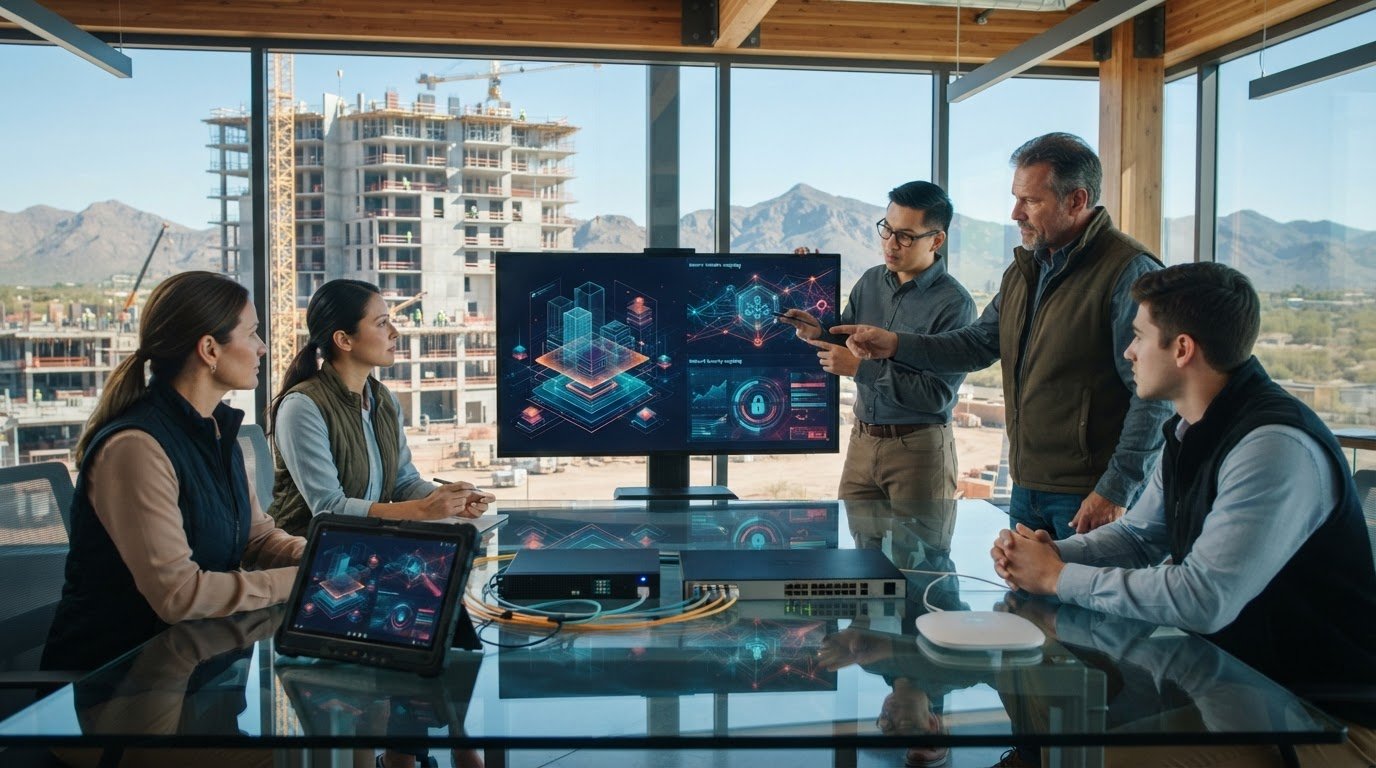
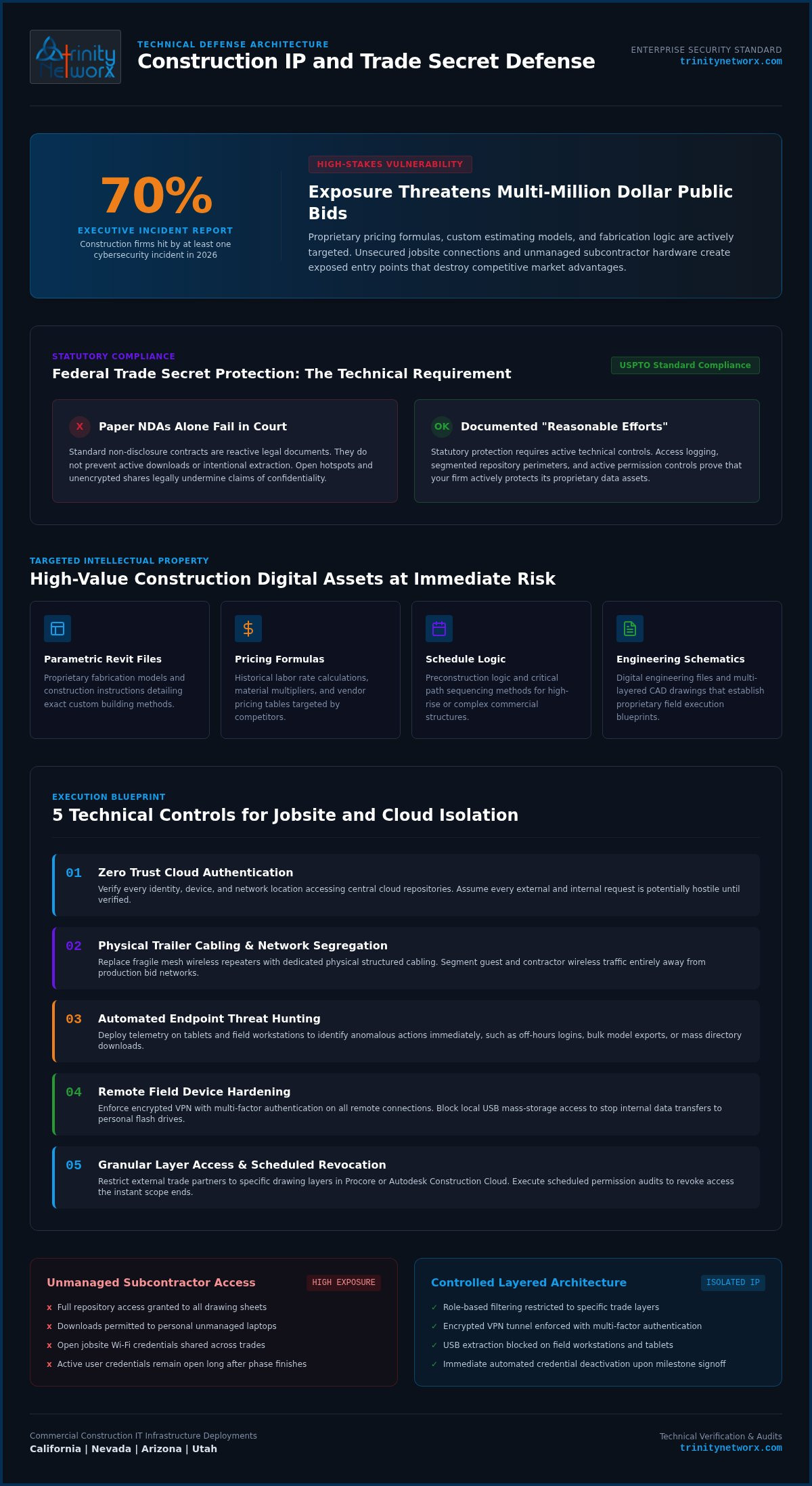
A staggering 70 percent of construction executives reported their firm experienced at least one cybersecurity incident in 2026. This is not just about lost emails. It is about losing a multi million dollar public bid because your proprietary pricing formula leaked to a competitor. You already know that unsecured jobsite Wi-Fi and subcontractors using personal devices create massive holes in your perimeter. Protecting trade secrets with cybersecurity is the only way to lock down your competitive advantage. We provide the exact technical controls needed to isolate proprietary drawings and bid models. This guide delivers a concrete checklist to secure sensitive data across every office and job trailer. We are moving past theoretical policies to deliver field tested protection for your intellectual property. Our focus remains on ensuring your field teams access sensitive models without risking corporate data leaks or competitive espionage.
• Identify specific intellectual property like BIM designs and estimating formulas to ensure your firm meets federal requirements for digital protection.
• Master the technical steps for protecting trade secrets with cybersecurity by implementing zero trust authentication across all cloud repositories.
• Secure jobsite trailers using dedicated physical cabling and segregated wireless networks to prevent unauthorized data access in the field.
• Control subcontractor risks by applying role-based permissions that restrict access to specific drawing layers instead of relying solely on legal agreements.
Modern construction is no longer just about concrete and steel. It is about data. Your proprietary estimating formulas and preconstruction schedule logics are the foundation of your competitive edge. If a competitor sees how you calculate labor costs or sequence a high rise, your advantage vanishes. Under federal law, protecting trade secrets with cybersecurity is a requirement for maintaining legal standing. A basic non-disclosure agreement is not enough. You must show "reasonable efforts" to maintain secrecy. If you use unprotected file shares or unencrypted plan distribution, you essentially hand your IP to the public. To understand the legal baseline, one must ask: What is a Trade Secret? In short, it is information with economic value that you actively hide.
Parametric Revit files and custom modular fabrication models carry enormous value. They aren't just drawings; they are instruction manuals for your specific building methods. Competitor espionage often targets historical labor rate sheets and vendor pricing tables to underbid you on future projects. Protecting trade secrets with cybersecurity means moving beyond simple passwords. You need technical barriers that prevent unauthorized copying or exporting of these files. For firms in California, Nevada, Arizona, and Utah, specialized it services commercial construction provides the necessary infrastructure to validate these security efforts. Without strict access controls, your digital engineering data fails to meet federal statutory secrecy rules. You cannot claim something is a secret if your jobsite Wi-Fi allows anyone to download the blueprints. Secrecy requires active, technical enforcement.
Implementing active defense is the next logical move. You've identified the IP. Now you must lock it down. Start with zero trust authentication. This framework assumes every connection is a threat until proven otherwise. It's a key component of USPTO trade secret protection strategies. By verifying every user and device accessing your cloud repositories, you stop unauthorized entry before it happens. Protecting trade secrets with cybersecurity isn't a one-time setup. It's a continuous process of verification.
Physical jobsite isolation is the second pillar. Don't let your field operations become a backdoor into corporate headquarters. We recommend dedicated physical cabling for job trailers rather than relying on mesh extensions. Segregate your commercial wireless networks to keep guest traffic far away from sensitive bid data. Finally, deploy automated endpoint threat hunting. Tablets and field workstations are prime targets. You need software that identifies suspicious behavior, such as bulk file exports or late-night logins, in real time.
Unprotected jobsite Wi-Fi is an open invitation for data theft. Kill the open hotspots immediately. Every field device must connect through an encrypted virtual private network with multi-factor authentication. To prevent internal leaks, block local USB extraction. This stops a departing employee from copying proprietary bidding models to a personal thumb drive. These controls are standard in our commercial construction IT services deployments. We ensure your field teams stay productive without creating security gaps. If your remote sites feel exposed, consult with our technical team about a jobsite security audit.
Legal agreements are necessary, but they are reactive. A signed non-disclosure agreement cannot physically stop a trade partner from downloading your entire bid model to an unmanaged personal laptop. Once that data leaves your environment, you lose control. Effective protecting trade secrets with cybersecurity requires technical enforcement that limits exposure. We advocate for role-based permissions within platforms like Procore or Autodesk Construction Cloud. An electrical subcontractor should only access relevant drawing layers, not your entire structural BIM library. This granular approach ensures that even if a partner's device is compromised, your core intellectual property remains shielded.
Revocation is just as critical as granting access. Many firms fail because they leave user credentials active long after a project phase concludes. You must implement scheduled permission audits. These reviews allow you to terminate credentials the moment a subcontractor's scope of work ends. This proactive stance prevents "zombie accounts" from becoming entry points for competitors or cybercriminals. Protecting trade secrets with cybersecurity means ensuring that access is a temporary privilege, not a permanent right.
Visibility into your project portals is non-negotiable. Configure watermarking on all sensitive documents to discourage unauthorized sharing. You should also disable bulk export functions to prevent mass data exfiltration. Reviewing outbound network traffic logs weekly helps catch suspicious activity before a bid closes. Many firms rely on managed cybersecurity services to gain this level of threat visibility. If you are unsure who currently has access to your proprietary plans, contact Trinity Networx to secure your supply chain today.
NDAs are just paper. Real security happens at the network level. You've learned that protecting trade secrets with cybersecurity requires zero trust authentication and strict jobsite isolation. You must revoke access the moment a subcontractor finishes their scope. Trinity Networx brings over 30 years of combined IT leadership to the table. We are a CIO Review recognized provider. Our technical staff is 100% US-based and understands the unique pressures of the construction field. We guarantee a response time under 20 minutes because we know downtime is not an option. Don't leave your bidding models and proprietary plans exposed to competitor espionage. Protect your proprietary project data today by scheduling a technical consultation at Trinity Networx Contact. Your hard earned intellectual property deserves professional protection.
The federal Defend Trade Secrets Act mandates that owners take reasonable measures to maintain secrecy to receive legal protection. If your firm fails to implement technical barriers, courts may rule that your proprietary data is not a trade secret. Protecting trade secrets with cybersecurity fulfills this statutory obligation. We implement these technical controls to ensure your intellectual property remains legally defensible across California and Utah.
Jobsite trailers often rely on temporary Wi-Fi hotspots that lack enterprise grade encryption. These open networks allow unauthorized users to intercept data packets containing sensitive Revit files. Without segregated commercial wireless networking, a single infected subcontractor device can compromise your entire project repository. Trinity Networx eliminates these gaps by deploying structured jobsite cabling and managed wireless setups tailored for field environments.
Builders maintain project speed by using role based access controls within their construction management software. This allows specialty contractors to see only the specific drawing layers they need for their scope of work. By automating these permissions, you prevent accidental data leaks without creating administrative bottlenecks. Our technical team coordinates your software workflows with your security needs to ensure field teams stay productive and secure.
A leak of proprietary estimating formulas usually results in losing multi million dollar public bids to competitors who now know your exact pricing logic. Beyond the immediate financial loss, a breach might disqualify your legal claims if you didn't prioritize protecting trade secrets with cybersecurity. We provide 24/7 monitoring to catch these exfiltration attempts before your competitive advantage is auctioned off to the highest bidder.

Article by
Lance Reichenberger, Ph.D.., J.D. (Candidate)
Dr. Lance Reichenberger is the founder of Trinity Networx, a Southern California technology firm specializing in managed IT services, cybersecurity, network infrastructure, and business technology strategy. With nearly four decades of experience in the IT industry, he works with businesses to improve operational efficiency, strengthen security, and align technology with long-term growth objectives.
Lance focuses on proactive IT management, enterprise wireless infrastructure, cybersecurity integration, and scalable technology solutions for growing organizations throughout Southern California.
The content published on this website is provided for general informational and educational purposes only. Articles may be created, edited, or enhanced with the assistance of artificial intelligence and automation tools under the direction and review of Trinity Networx. While every effort is made to ensure accuracy and relevance, the information provided should not be considered professional, legal, financial, cybersecurity, or technical advice specific to your organization. Businesses should consult directly with a qualified professional regarding their unique environment, compliance requirements, and operational needs. Trinity Networx makes no warranties regarding completeness, reliability, or applicability of the information contained within these articles.
Schedule a brief conversation with Trinity Networx to discuss your business technology needs.
Get a practical roadmap built around your business, your users, your systems, and the technology issues that need attention first.
Put the right technology, support, security, and infrastructure in place so your business can grow, adapt, and move forward with confidence.