3281 E. Guasti Rd, STE 700, Ontario, CA 91761
1712 9th Ave SW, Watertown, SD 57201
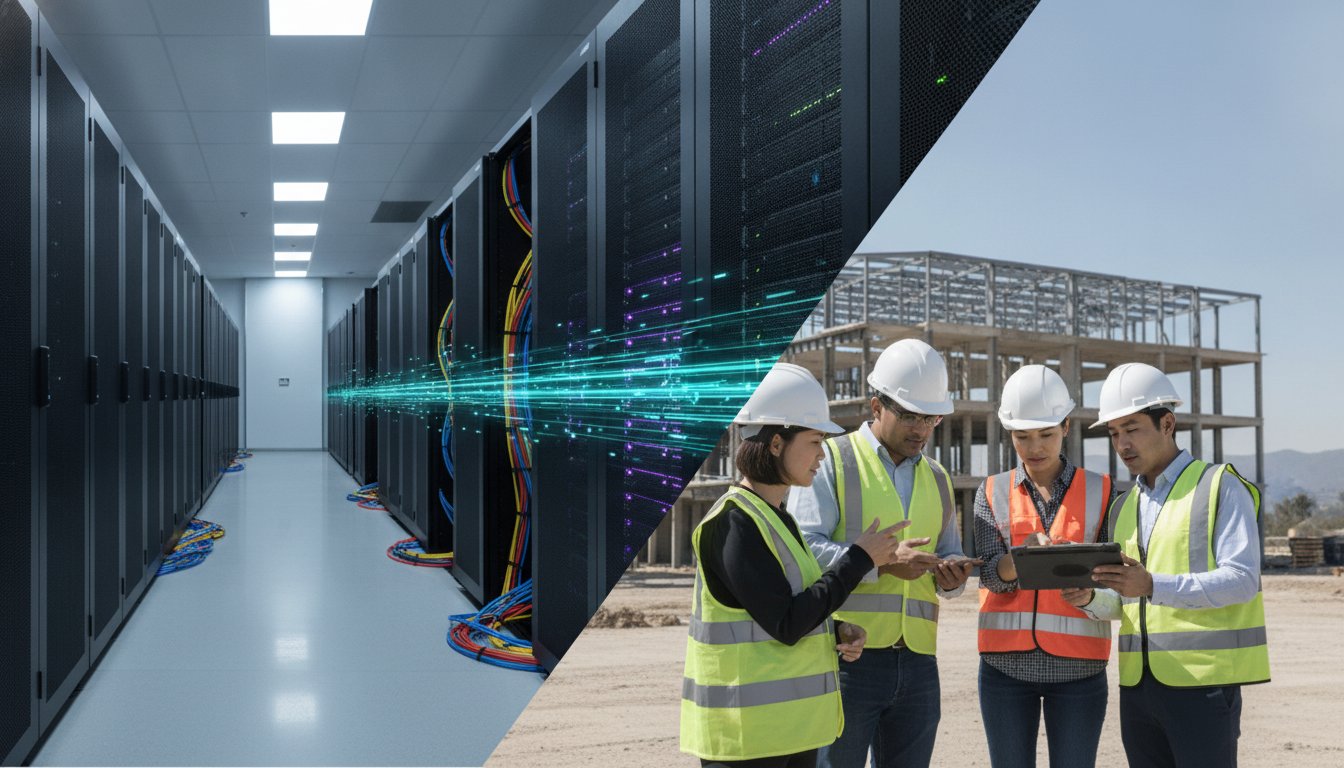
Every piece of server hardware you buy for a job site starts losing value the second you peel off the plastic. It is a sunk cost. These machines sit in trailers, battling dust and heat while slowly eating your project profits. You are likely tired of the cycle where a new contract triggers a massive bill for servers and storage that you might not even need next year. Upfront infrastructure costs for traditional IT can easily hit 100,000 dollars before the first shovel hits the ground. Strategically reducing capital expenditure with cloud services turns those heavy upfront burdens into manageable, predictable operating costs that reflect the reality of your workflow.
We understand the frustration of technology failing in the field. It happens. A surprise repair bill hits your desk just as you are trying to close a job. You need technology to move at the speed of your business. This article explains how managed cloud services protect your bottom line by providing instant scalability and superior data security without the massive initial investment. We will look at the shift from depreciating assets to high performance cloud environments that keep your margins where they belong.
• Stop wasting cash on servers that fail in harsh job site conditions like dust and extreme heat.
• Discover the financial benefits of reducing capital expenditure with cloud services by shifting IT costs into a predictable monthly operational budget.
• Give field teams immediate access to heavy BIM and CAD files from any job site through virtual desktop infrastructure.
• Deploy new project environments in 40 minutes or less using cloud solutions in Ontario to ensure technology keeps pace with your contract signings.
• Eliminate surprise repair bills and technology bottlenecks that threaten your project profit margins.
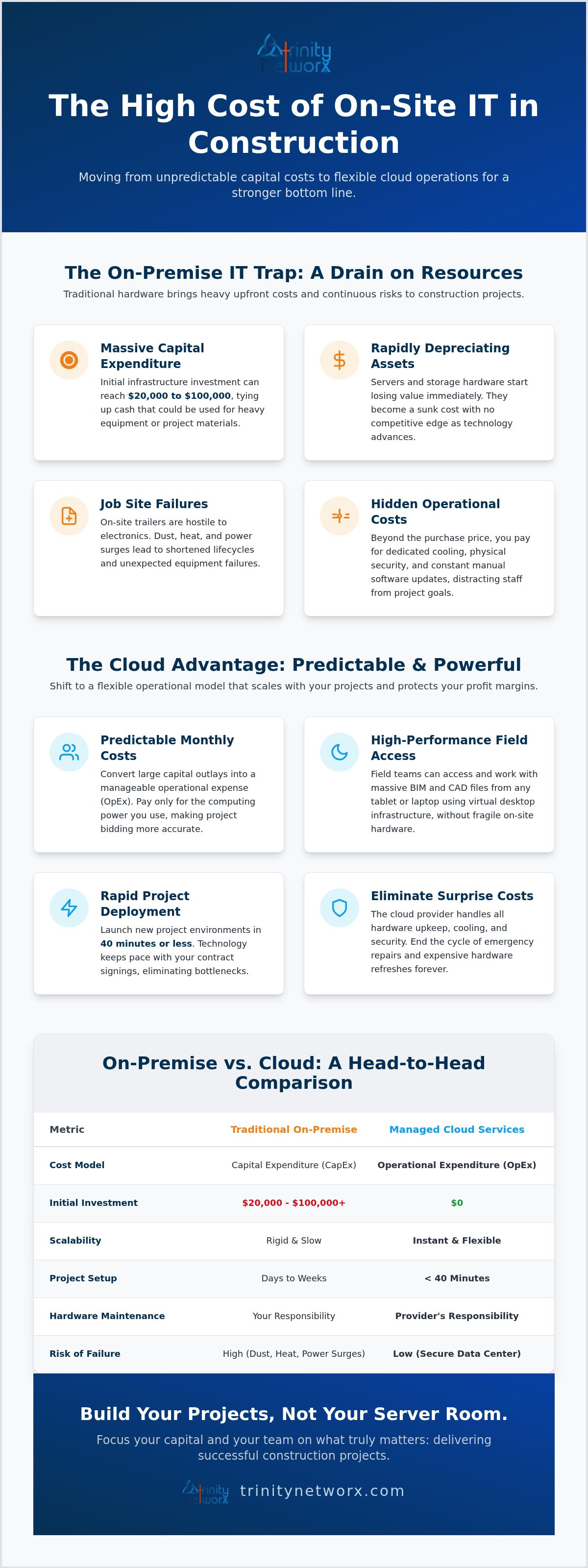
Buying a physical server for a construction office is like buying a truck that starts rusting the moment it leaves the lot. Traditional Capital expenditure requires a massive upfront investment. You drop 20,000 to 100,000 dollars on servers, storage arrays, and networking gear before the project even breaks ground. This is cash that could have stayed in your bank account or gone toward heavy equipment. Instead, it's tied up in silicon and metal that loses value every single day. It is a sunk cost that provides no competitive edge once the next generation of hardware arrives.
The environment on a job site is inherently hostile to delicate electronics. Dust finds its way into every fan. Heat in a field trailer stresses processors. Power surges from heavy machinery can fry sensitive circuits in an instant. These factors drastically shorten the life cycle of your IT hardware. Beyond the purchase price, you face hidden costs like dedicated cooling systems, physical security for the server room, and the constant labor required for manual software updates. You're paying your staff to babysit machines instead of moving projects forward. The 'Construction Tax' is the direct loss in project profit caused by depreciating technology that fails well before its expected expiration date.
Purchasing hardware for a specific three year project often creates a financial debt that lingers long after the job site is cleared. You're left with specialized gear that might not fit the needs of your next contract. This mismatch forces firms into a cycle of constant buying. On top of that, manual hardware refreshes are notorious for triggering unplanned downtime. When a field server goes down for an update or a part replacement, job site productivity stops. Reducing capital expenditure with cloud services stops this cycle by removing the physical burden from the field trailer entirely.
Traditional IT infrastructure is a rigid cost center. You buy for peak capacity but often leave resources idling. Switching to an operational expenditure model means you pay only for the computing power you actually use today. This flexibility is the core benefit of reducing capital expenditure with cloud services. It removes the burden of owning depreciating assets. Instead of a massive server room at headquarters, you reclaim that square footage for billable staff. Your technology spend finally aligns with your actual project pipeline. If you land three new contracts, you scale up. If things slow down, you pull back. There is no wasted capacity.
Field teams often struggle with massive BIM or CAD files on site. Local hardware usually chokes on these datasets. By implementing virtual desktop infrastructure, your engineers access high performance workstations from any tablet or laptop. The heavy lifting happens in a secure data center, not on a fragile field laptop. This shift reflects broader trends in Federal Cloud Computing Challenges, where organizations move away from hardware ownership to gain agility. You get the power of a workstation without the price tag of a physical machine.
Accuracy in bidding is the difference between profit and loss. Cloud subscriptions offer a fixed, per-user cost that is easy to bake into your estimates. You no longer have to guess about IT overhead or worry about a server failing mid-project. Subcontractors often face the shock of emergency hardware replacements that destroy their margins. With cloud hosting, those surprises vanish. If you want to see how a flat-fee model can stabilize your project budgets, speak with our team today.
Hardware maintenance is a distraction from your core business. In a cloud environment, the provider handles the physical upkeep, cooling, and security. Your team stays on the fastest equipment without you ever writing a check for a new chassis. This shifts the labor cost of updates and security patches to a managed partner. Your internal staff can focus on project delivery rather than troubleshooting old hardware.
Mobilizing a new job site should not be a weeks-long logistical nightmare. When you win a contract, you need your team working immediately. Using cloud solutions in Ontario allows you to bypass the hardware procurement delay. We use rapid virtualization to spin up new servers or virtual machines in 30 to 40 minutes. This speed is a primary factor in reducing capital expenditure with cloud services. You stop paying for idle capacity. You start paying for production the moment it begins. It is that simple.
Project continuity depends on data availability. Local storage is a risk in a dusty trailer. Off-site data storage keeps your blueprints and contracts safe from local disasters or hardware failure. Instead of sinking money into expensive, bulky server racks, you can pivot your budget toward IT hardware solutions that prioritize mobile, field-ready devices. This approach keeps your field teams agile and your central office lean. Efficiency is the priority.
Generic IT vendors don't understand the specific pressure of a concrete pour or a tight inspection window. We focus on the software and workflows that drive Southern California construction firms. Our team ensures your technology supports your project milestones rather than obstructing them. Contact us for a Free Network Assessment to identify exactly where your current setup is leaking cash. We will show you how to move away from the CapEx trap and protect your project margins. It is time to work smarter.
Trinity Networx, LLC stands as a dedicated partner for firms throughout Southern California. We eliminate the uncertainty of technical repair bills with our flat-fee pricing model. No hidden charges. No surprise invoices. Our 100% in-house team provides a 60-minute response guarantee to keep your job sites moving at full speed. You can finally exit the hardware refresh cycle and focus on delivering high-quality projects. Secure your project profits by contacting Trinity Networx, LLC today.
Cloud services turn unpredictable IT costs into a fixed line item. When you bid on a contract, you know exactly what your monthly technology expense will be per user. This level of precision is a major advantage of reducing capital expenditure with cloud services. You avoid the risk of a legacy server failing mid-project and eating your profit margin with an emergency replacement bill. Your bid stays accurate because your costs stay stable.
We assess your current assets to determine their remaining value. Some firms use old servers for local, secondary backups or non-critical file storage during the transition. However, the goal is to move away from the maintenance burden entirely. Once your data is migrated, you can retire aging machines and reclaim the space in your office. This stops the drain on your utility bills and eliminates the need for specialized cooling for on-site racks.
Cloud environments offer security levels that few local server rooms can match. Your blueprints and contracts are protected by enterprise-grade encryption and multi-factor authentication. Data centers are monitored 24/7 and include redundant power systems. This setup prevents data loss from local hardware failure or site theft. You maintain full control over who accesses specific files while ensuring your project data is backed up automatically across multiple geographic locations.
Modern cloud applications are built for the reality of the field. Many platforms include offline modes that sync your work once a connection is restored. For heavy CAD or BIM files, we use virtual desktops that only transmit screen pixels rather than the entire file. This method requires significantly less bandwidth than traditional file sharing. It allows your team to stay productive even on sites with limited connectivity without sacrificing the benefits of reducing capital expenditure with cloud services.

Article by
Lance Reichenberger, Ph.D.., J.D. (Candidate)
Dr. Lance Reichenberger is the founder of Trinity Networx, a Southern California technology firm specializing in managed IT services, cybersecurity, network infrastructure, and business technology strategy. With nearly four decades of experience in the IT industry, he works with businesses to improve operational efficiency, strengthen security, and align technology with long-term growth objectives.
Lance focuses on proactive IT management, enterprise wireless infrastructure, cybersecurity integration, and scalable technology solutions for growing organizations throughout Southern California.
The content published on this website is provided for general informational and educational purposes only. Articles may be created, edited, or enhanced with the assistance of artificial intelligence and automation tools under the direction and review of Trinity Networx. While every effort is made to ensure accuracy and relevance, the information provided should not be considered professional, legal, financial, cybersecurity, or technical advice specific to your organization. Businesses should consult directly with a qualified professional regarding their unique environment, compliance requirements, and operational needs. Trinity Networx makes no warranties regarding completeness, reliability, or applicability of the information contained within these articles.
Schedule a brief conversation with Trinity Networx to discuss your business technology needs.
Get a practical roadmap built around your business, your users, your systems, and the technology issues that need attention first.
Put the right technology, support, security, and infrastructure in place so your business can grow, adapt, and move forward with confidence.