3281 E. Guasti Rd, STE 700, Ontario, CA 91761
1712 9th Ave SW, Watertown, SD 57201
Lance Reichenberger, Ph.D.
Contact Trinity Networx, LLC: contact us | Share on Social Media
The construction sector accounted for 11.4 percent of all ransomware victims in September 2025. You know the pressure of a deadline. Field teams need Revit files immediately. When the office server lags, workers use personal accounts to get the job done. This shadow IT creates a massive security hole for your bid documents and schedules. Secure file sharing for construction project management isn't just about picking a software app. It's about building a digital fortress that doesn't slow down your crew.
You can protect sensitive project data and maintain strict version control without forcing your team to wait on slow downloads. I agree that speed is your primary driver. This article shows you how to eliminate the risks of unmanaged file sharing while meeting the strict demands of CMMC 2.0 and CCPA. We will preview why your strategy must be a function of managed infrastructure rather than just a monthly subscription. Stop reacting to security threats. Start driving project progress with a proactive plan from Trinity Networx, LLC that keeps your data locked down and your teams moving fast.
• Eliminate the security gaps created by shadow IT. Stop field teams from using personal apps that expose your project data.
• Control your bid documents with role based access. Grant specific permissions so subcontractors only see what they need.
• Secure high value contracts by meeting CMMC 2.0 and California data standards. Compliance is your ticket to defense and infrastructure projects.
• Deploy secure file sharing for construction project management through managed infrastructure. Speed matters when your crew needs Revit or CAD files on the jobsite.
• Switch to proactive IT support. A 20 minute response time ensures your field teams stay productive during technical glitches.
Lance Reichenberger, Ph.D.
Contact us: contact us | Share on Social Media
Speed kills security on a jobsite. Your field teams need answers now. When the official system lags, they turn to personal accounts to move files. This habit, known as shadow IT, is a direct liability for project managers that compromises the entire organization's safety. It's not just about convenience; it's about control. Secure file sharing for construction project management requires a foundation that consumer grade apps simply cannot provide.
Generic cloud drives aren't built for the hierarchy of a multi million dollar build. You have general contractors, dozens of subcontractors, and architects all needing different access levels. Consumer tools lack the granular permissions required to keep these groups separated. If a subcontractor sees a bid document they shouldn't, your profit margins evaporate. Unlike professional Capital program management software, personal drives often treat every user with the same broad brush. This lack of precision leads to data leakage that can kill your competitive edge before the first shovel hits the dirt.
Effective IT management ensures that speed doesn't come at the cost of visibility. When project data lives on a superintendent's personal phone, it's invisible to your security protocols. You can't protect what you can't see.
Accountability vanishes without a clear record. If a dispute arises over a specific RFI, you need an audit trail. Consumer apps rarely offer the deep logging necessary to prove who opened, edited, or shared a file. You're left guessing in a high stakes environment where proof is everything. Missing trails lead to legal exposure and finger pointing that stalls progress.
Accidental deletions are another silent project killer. In an unmanaged environment, one wrong click by a tired foreman can wipe out weeks of engineering specs. Without enterprise grade recovery, those files are gone. Project delays follow. Costs spiral. Your reputation takes the hit. Proper secure file sharing for construction project management prevents these catastrophes by keeping your data within a controlled, recoverable ecosystem.
Lance Reichenberger, Ph.D.
Contact us: contact us | Share on Social Media
AEC projects live and die by the accuracy of their drawings. If your secure file sharing for construction project management lacks native file handling, your field teams are already at a disadvantage. Waiting for a massive Revit or CAD file to download locally before opening it creates friction. Professional systems allow users to view and mark up these files directly within the cloud environment. This speed keeps the project moving.
Ensuring that these accurate drawings translate correctly to the field often requires high-precision positioning tools, such as GNSS Network Subscription Services, which provide the location data necessary for surveying and automated machine control.
Security must be active, not just a checkbox. End to end encryption protects your bid documents while they travel across the web and while they sit on the server. You need role based access control to partition your data properly. Subcontractors should only see the folders relevant to their specific trade. This prevents curious eyes from wandering into sensitive financial data or other trades' proprietary methods. A Managed IT infrastructure provides the backbone for these high performance exchanges.
Following core cybersecurity practices is a baseline for any modern builder. It's about protecting your profit and your reputation. Deploying secure file sharing for construction project management requires more than just a login. If you're ready to secure your project data, talk to our experts today.
Working off the wrong set of plans is an expensive mistake. Real time syncing ensures that every tablet on the jobsite reflects the latest revision from the architect's office. When one user opens a master file, locking mechanisms prevent others from making conflicting edits. This eliminates "save-over" wars that corrupt data and force teams to redo hours of work.
Jobsite theft happens. If a tablet goes missing, remote wipe capabilities allow you to erase project data instantly. Multi factor authentication is a non negotiable requirement for every person accessing your network. It's the most effective way to stop unauthorized access even if a password is leaked. We don't settle for "good enough" security when your contracts are on the line.
Lance Reichenberger, Ph.D.
Contact us: contact us | Share on Social Media
Winning a contract in California often means proving your security before you ever break ground. For defense and infrastructure projects, CMMC 2.0 is fully enforceable as of February 2026. This isn't a suggestion. It's a mandatory condition for award. If your secure file sharing for construction project management doesn't meet Department of Defense standards, you're locked out of the bidding pool. We see firms lose out because they treated security as an afterthought.
California adds its own layers of complexity to these federal rules. State projects demand strict adherence to data residency and protection standards. As of January 1, 2023, the CPRA amendments to the CCPA are in full effect. Even more critical, new regulations starting January 1, 2026, require businesses meeting certain thresholds to conduct annual cybersecurity audits. These audits focus heavily on how you handle sensitive information. You need a partner who understands the local landscape.
Audit logs are your best defense during an inspection. You must preserve these records to meet document retention requirements. This is a key part of protecting critical infrastructure from evolving threats. If you can't prove who accessed a file three years ago, you're non compliant. Expert CMMC compliance consultants can help you navigate these shifting requirements and keep your bids competitive.
Is your current setup ready for a state or federal audit? Contact us to verify your compliance status.
Blueprints are more than just drawings. They often contain controlled unclassified information (CUI) that requires high level protection. To reach CMMC Level 2, you must implement the 110 security controls defined by NIST 800 171. This includes how you manage secure file sharing for construction project management when collaborating with external partners. Don't wait for a failed audit to fix your infrastructure. Stability and security go hand in hand.
Lance Reichenberger, Ph.D.
Contact us: contact us | Share on Social Media
Software picks are easy. Managing the underlying systems is where most firms fail. If your connection drops in a remote canyon site in Riverside or a dense build in San Diego, your software is useless. You need local Southern California support that understands these regional hurdles. Reliable Managed IT services provide the necessary backbone for secure file sharing for construction project management. We don't just set up a login; we ensure the data actually flows across every jobsite.
Proactive monitoring stops disasters before they reach the superintendent's trailer. We watch for spikes in data traffic or unauthorized access attempts in real time. This isn't passive support. It's active defense. If a technical glitch occurs, our 20 minute response time keeps your field teams productive. Waiting hours for a callback costs thousands in idle labor and missed deadlines. We prioritize uptime because we know that project schedules are unforgiving and liquidated damages are real.
Our team focuses on the practical business impact of your technology. When your field to office connectivity is stable, your overhead drops. You spend less time fighting with CAD files and more time hitting milestones. We act as a strategic partner that values your growth above all else. This approach treats your technology as a driver of progress rather than a simple utility.
Security is a constant process. Regular vulnerability assessments find weak spots in your sharing workflow before bad actors do. We test your defenses against modern threats like AI powered phishing. Training your crew is just as vital. One clicked link in a fake invoice email can hand over project credentials to a criminal. We teach your staff to spot these traps through ongoing education. This creates a human firewall that protects your blueprints and your bottom line. Stability isn't an accident. It's the result of professional oversight.
Lance Reichenberger, Ph.D.
Contact Trinity Networx, LLC: contact us | Share on Social Media
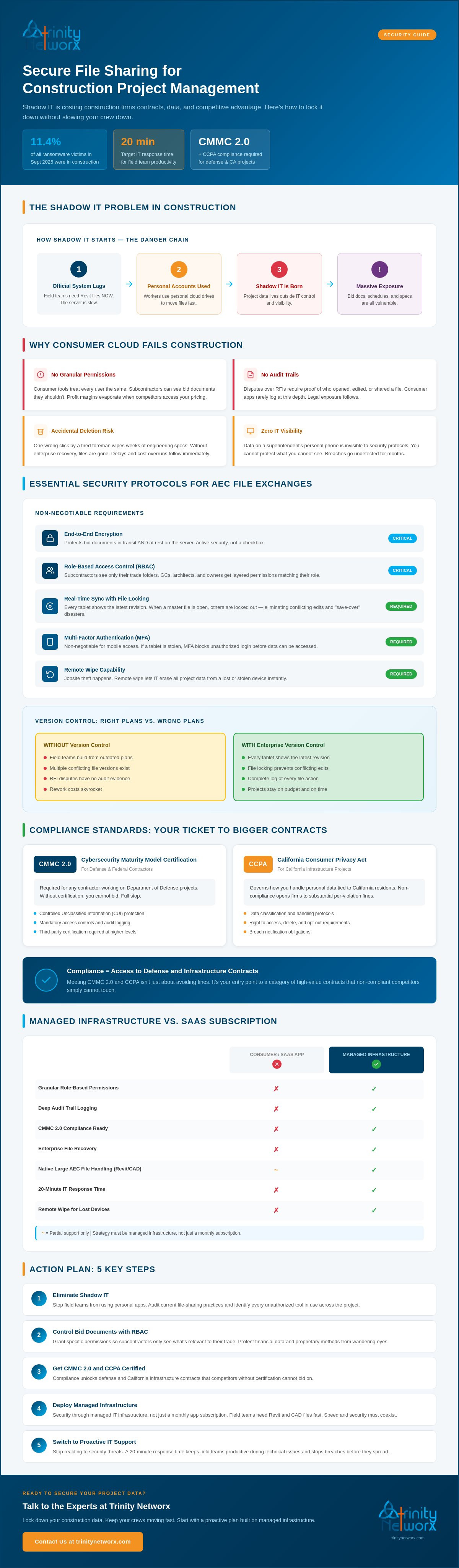
Data security isn't a luxury for the construction office. It's a requirement for winning contracts and keeping your jobsites running. You've seen how consumer drives expose your profits to ransomware. You know shadow IT erodes your control. Secure file sharing for construction project management succeeds only when it's backed by a managed infrastructure that supports massive AEC files without lag. Compliance with CMMC 2.0 and California state laws is the new baseline for staying in the game. Don't let a slow connection or a security gap stall your progress.
Trinity Networx, LLC brings specialized AEC industry experience to your project ecosystem. We don't just fix computers. We provide proactive cybersecurity monitoring that hunts for threats before they cause downtime. Our 20 minute response time guarantee means your field teams never sit idle during a technical glitch. Stop reacting to security gaps. Start building on a foundation of professional reliability.
Secure your project data today by contacting Trinity Networx, LLC. Build with the confidence that your data is locked down and your teams are moving forward.
Lance Reichenberger, Ph.D.
Contact us: contact us | Share on Social Media
You secure large CAD files by implementing role based access control and native file handling. This setup allows subcontractors to view drawings within a browser or app without downloading the raw data to an unmanaged device. It keeps your intellectual property inside your firewall. When you stop local downloads, you stop unauthorized sharing. This approach maintains high speed access while keeping your engineering specifications private.
Generic tools cannot meet CMMC compliance because they lack the specific security controls required by NIST 800 171. Since February 2026, the Department of Defense has made CMMC 2.0 a mandatory condition for contract awards. Most consumer drives don't offer the deep audit trails or data residency controls needed for federal work. Relying on them is a fast way to get disqualified from lucrative infrastructure projects.
A leak of sensitive bid documents results in the immediate loss of your competitive advantage and potential legal action. Under California's CPRA, which took full effect in January 2023, businesses face strict penalties for failing to protect personal and project data. You also risk your standing with the Department of Defense if the data contains controlled unclassified information. The financial hit from a single breach can exceed the cost of professional security.
Connectivity is the backbone of secure file sharing for construction project management. When field speeds are slow, crews bypass secure protocols to use faster personal apps. This creates shadow IT risks that are invisible to your office. Managed infrastructure ensures that your field teams have the bandwidth to access secure documents without resorting to risky shortcuts. High performance connectivity is a security requirement for any modern jobsite.
Version control is a matter of data integrity. If a subcontractor works off an outdated drawing, the resulting rework causes massive project delays and budget overruns. Security isn't just about hiding data; it's about ensuring the information is accurate and current. Proper locking mechanisms prevent multiple users from creating conflicting file versions. This keeps the master record clean and protects the project from preventable engineering errors.

Article by
Lance Reichenberger, Ph.D.., J.D. (Candidate)
Dr. Lance Reichenberger is the founder of Trinity Networx, a Southern California technology firm specializing in managed IT services, cybersecurity, network infrastructure, and business technology strategy. With nearly four decades of experience in the IT industry, he works with businesses to improve operational efficiency, strengthen security, and align technology with long-term growth objectives.
Lance focuses on proactive IT management, enterprise wireless infrastructure, cybersecurity integration, and scalable technology solutions for growing organizations throughout Southern California.
The content published on this website is provided for general informational and educational purposes only. Articles may be created, edited, or enhanced with the assistance of artificial intelligence and automation tools under the direction and review of Trinity Networx. While every effort is made to ensure accuracy and relevance, the information provided should not be considered professional, legal, financial, cybersecurity, or technical advice specific to your organization. Businesses should consult directly with a qualified professional regarding their unique environment, compliance requirements, and operational needs. Trinity Networx makes no warranties regarding completeness, reliability, or applicability of the information contained within these articles.
Schedule a brief conversation with Trinity Networx to discuss your business technology needs.
Get a practical roadmap built around your business, your users, your systems, and the technology issues that need attention first.
Put the right technology, support, security, and infrastructure in place so your business can grow, adapt, and move forward with confidence.