3281 E. Guasti Rd, STE 700, Ontario, CA 91761
1712 9th Ave SW, Watertown, SD 57201

Commercial contractors waste thousands of dollars every month keeping single-application physical servers on life support. Running isolated machines just to host one accounting database or estimating tool drains capital fast. You already feel the strain of inflated replacement quotes and soaring power bills for aging server rooms, especially when jobsite trailers lose access to critical blueprints during hardware failures. Forward-thinking firms deploy server virtualization to reduce hardware costs without sacrificing field reliability.
Discover how commercial contractors eliminate bloated server racks and trim equipment spending with targeted server virtualization. You will see how consolidating fragmented machines into reliable host environments cuts hardware refresh cycles and maintenance expenses by over thirty percent. Here is how modern builders protect jobsite uptime, retire fragile equipment, and build lean systems that support demanding project teams.
• Commercial contractors apply server virtualization to reduce hardware costs by consolidating isolated workloads onto unified physical hosts, ending the expense of underworked server towers.
• Avoid forced three-year hardware refreshes by expanding system memory and disk allocation directly without purchasing expensive replacement equipment.
• Protect remote jobsite connectivity to blueprints and accounting databases by eliminating fragile physical machines that threaten project schedules during outages.
• Deploy hypervisor host systems that enable rapid server spin-up in thirty to forty minutes to keep field crews productive without emergency maintenance fees.
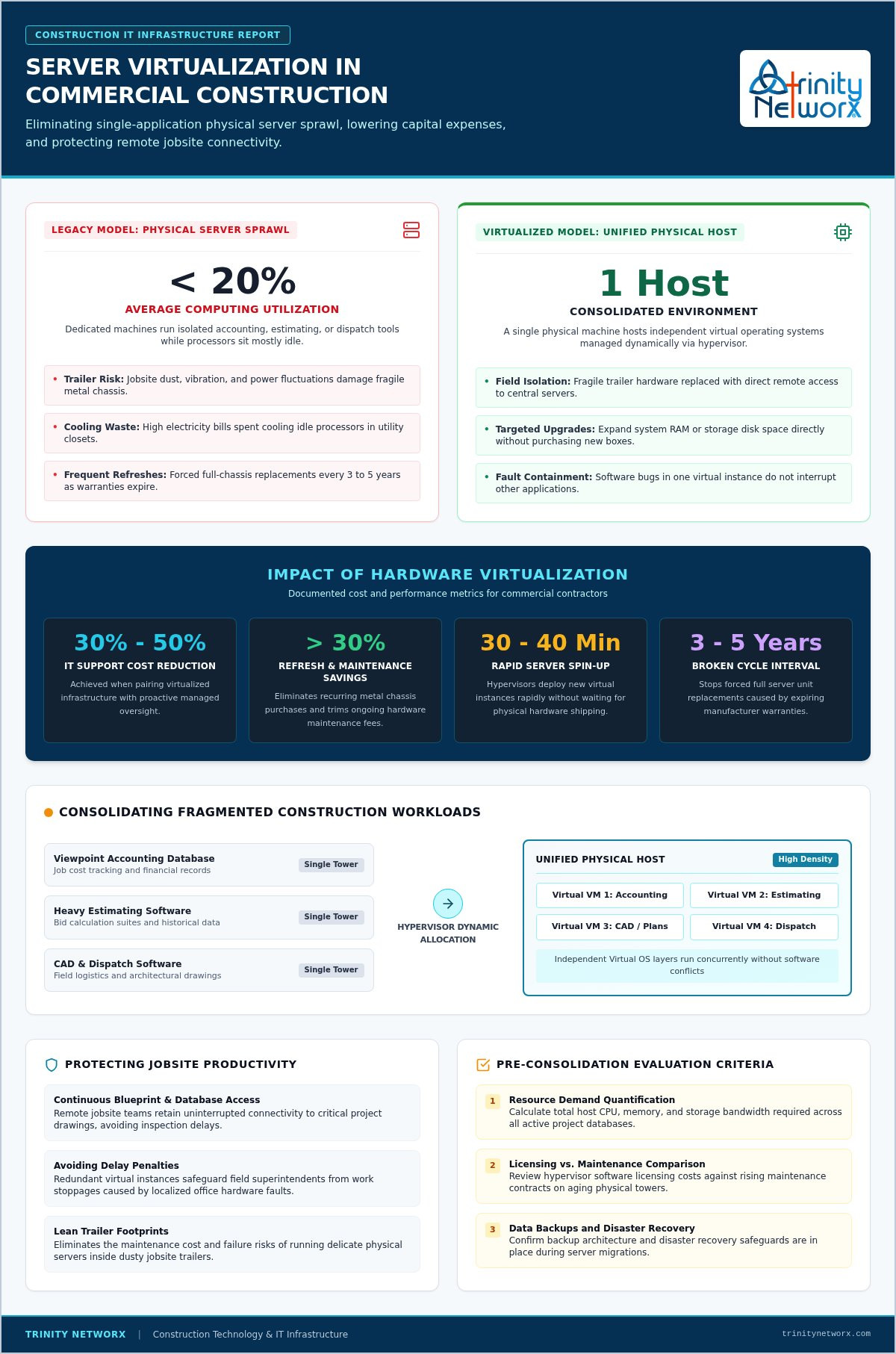
Most commercial contractors purchase independent server towers whenever they adopt new construction platforms. One machine handles Viewpoint accounting. Another runs heavy estimating databases. A third handles dispatch software. This setup is expensive and deeply inefficient. Contractors often average under twenty percent computing utilization on these dedicated units, wasting immense power to cool idle processors in dusty utility closets.
Hardware virtualization changes this balance. It enables multiple independent virtual operating systems to run on a single physical host machine. Hypervisors separate system resources dynamically, letting disparate databases run side by side without application conflicts. Commercial contractors deploy server virtualization to reduce hardware costs because consolidating isolated databases onto high-density physical equipment slashes immediate chassis purchases and caps future physical replacement budgets.
Scattering dedicated servers across main offices and jobsite construction trailers creates endless IT bills. Fragile trailer environments ruin delicate circuit boards with dust, vibration, and fluctuating power. Virtual partitions eliminate this vulnerability. Individual applications function independently without buying distinct metal chassis for every operational need. Field teams access central virtual machines remotely while local trailer setups stay lean.
• Consolidates bidding, accounting, and CAD software onto unified hardware.
• Reduces power consumption and heat generation across office server rooms.
• Shields project workflows from hardware failure in rough jobsite conditions.
Before ordering another machine for an upcoming project, check our IT infrastructure project planning to audit your current equipment sprawl before purchasing new machines.
Every three to five years, general contractors face the same expensive crossroad. Aging physical servers lose manufacturer warranty coverage, spare parts become scarce, and hardware vendors push costly full-unit replacements. Upfront capital outlays for new server towers and extended service warranties strain company cash flow quickly. A virtual architecture breaks this cycle. Instead of replacing four or five discrete towers, builders upgrade computing memory or disk space on existing equipment without buying new metal chassis.
Industry analyses detailing the benefits of server virtualization point out that running isolated virtual workloads on dense host systems curbs both capital expenditures and long-term facility cooling overhead. Pairing virtualized architecture with proactive managed oversight cuts overall IT support costs thirty to fifty percent. It also ensures operational continuity. If one virtual instance encounters a software bug, other systems remain operational. Redundant virtual machines hosted on monitored units protect field superintendents from work stoppages, avoiding missed inspection milestones and delay penalties.
Transitioning away from legacy physical boxes demands careful preparation. Infrastructure needs vary widely based on your bidding platforms, project management suites, and mobile jobsite sync frequency.
• Calculate total host memory and storage bandwidth required across all active databases.
• Review hypervisor software licensing costs against ongoing maintenance contracts on aging hardware.
• Ensure your business safeguards core operations with reliable data backups and disaster recovery during any major infrastructure transition.
Smart builders implement server virtualization to reduce hardware costs while securing their data foundation. If your current warranties are expiring, you can speak with our infrastructure specialists to review your server replacement timeline.
Transitioning away from physical server clusters starts with a granular audit of your technology footprint. You must quantify CPU demands, memory usage, and remote bandwidth needs across estimating tools, job cost accounting, and scheduling software. Sizing unified host equipment accurately prevents overbuying hardware while giving virtual machines ample room to process heavy blueprint files. System migrations happen in controlled phases during off-hours, ensuring estimators meeting tight bidding deadlines face zero unexpected software lockouts.
General contractors adopt server virtualization to reduce hardware costs while dramatically speeding up disaster recovery. If a host encounters trouble, hypervisors enable rapid server spin-up in thirty to forty minutes. This eliminates multi-day delays spent sourcing replacement server motherboards or shipping components to remote project trailers.
Reliable virtual infrastructure requires persistent oversight. An in-house network operations center monitoring networks twenty-four hours daily catches temperature spikes and disk degradation before equipment fails. When hardware faults do occur, automated failover instantly restores operations:
• Keeps project managers, foremen, and field crews connected to live plan revisions.
• Eliminates expensive emergency technician callout fees through proactive monitoring.
• Protects critical jobsite milestones against hardware-driven schedule slips.
Partner with experienced engineers for commercial construction IT services that keep your field crews operational and your hardware lean.
Commercial contractors no longer need to accept bloated server closets and volatile hardware replacement prices. Consolidating isolated databases onto unified host architecture eliminates underused compute capacity while safeguarding field operations against unexpected jobsite downtime. Adopting server virtualization to reduce hardware costs gives your company predictable IT spending and protects active projects from costly equipment failures.
Recognized among the CIO Review 20 Most Promising IT Services Companies, Trinity Networx delivers rapid server spin-up in thirty to forty minutes and flat-fee managed network plans cutting IT support costs thirty to fifty percent. Take control of your technology budget before another forced replacement cycle hits. Schedule your consultation with Trinity Networx to eliminate unnecessary server purchases today.
Contractors deploy server virtualization to reduce hardware costs by consolidating multiple physical machines into a single high-density host. Instead of purchasing distinct servers for accounting, project dispatch, and estimating platforms, you run each workload in separated virtual environments. This cuts upfront equipment purchases, trims annual hardware warranty renewals, and lowers power draw across your Nevada, California, or regional jobsite offices.
No. Modern hypervisors dedicate physical processor cores and memory dynamically to heavy workloads like Viewpoint, Procore, or CAD tools. Rather than competing for resources, your databases operate inside dedicated resource boundaries. Performance often improves because newer host hardware delivers faster clock speeds and higher throughput than aging, single-purpose server towers sitting in unventilated jobsite trailers or supply rooms.
Recovery happens in thirty to forty minutes. Trinity Networx deploys Datto-backed continuity solutions that take snapshots of your virtual machines and spin them up rapidly on secondary hardware or isolated appliances. While our Southern California NOC resolves the hardware fault, field superintendents and estimators continue working without lost drawing revisions, corrupt bid files, or multi-day downtime delays.
Yes. Replacing five or six older physical servers with a single host significantly drops total electrical draw. Aging servers run inefficient power supplies that generate excess heat. When commercial builders use server virtualization to reduce hardware costs, their server rooms pull less current and require less supplemental air conditioning, eliminating the need to install expensive new electrical circuits or subpanels.

Article by
Lance Reichenberger, Ph.D.., J.D. (Candidate)
Dr. Lance Reichenberger is the founder of Trinity Networx, a Southern California technology firm specializing in managed IT services, cybersecurity, network infrastructure, and business technology strategy. With nearly four decades of experience in the IT industry, he works with businesses to improve operational efficiency, strengthen security, and align technology with long-term growth objectives.
Lance focuses on proactive IT management, enterprise wireless infrastructure, cybersecurity integration, and scalable technology solutions for growing organizations throughout Southern California.
The content published on this website is provided for general informational and educational purposes only. Articles may be created, edited, or enhanced with the assistance of artificial intelligence and automation tools under the direction and review of Trinity Networx. While every effort is made to ensure accuracy and relevance, the information provided should not be considered professional, legal, financial, cybersecurity, or technical advice specific to your organization. Businesses should consult directly with a qualified professional regarding their unique environment, compliance requirements, and operational needs. Trinity Networx makes no warranties regarding completeness, reliability, or applicability of the information contained within these articles.
Schedule a brief conversation with Trinity Networx to discuss your business technology needs.
Get a practical roadmap built around your business, your users, your systems, and the technology issues that need attention first.
Put the right technology, support, security, and infrastructure in place so your business can grow, adapt, and move forward with confidence.