3281 E. Guasti Rd, STE 700, Ontario, CA 91761
1712 9th Ave SW, Watertown, SD 57201

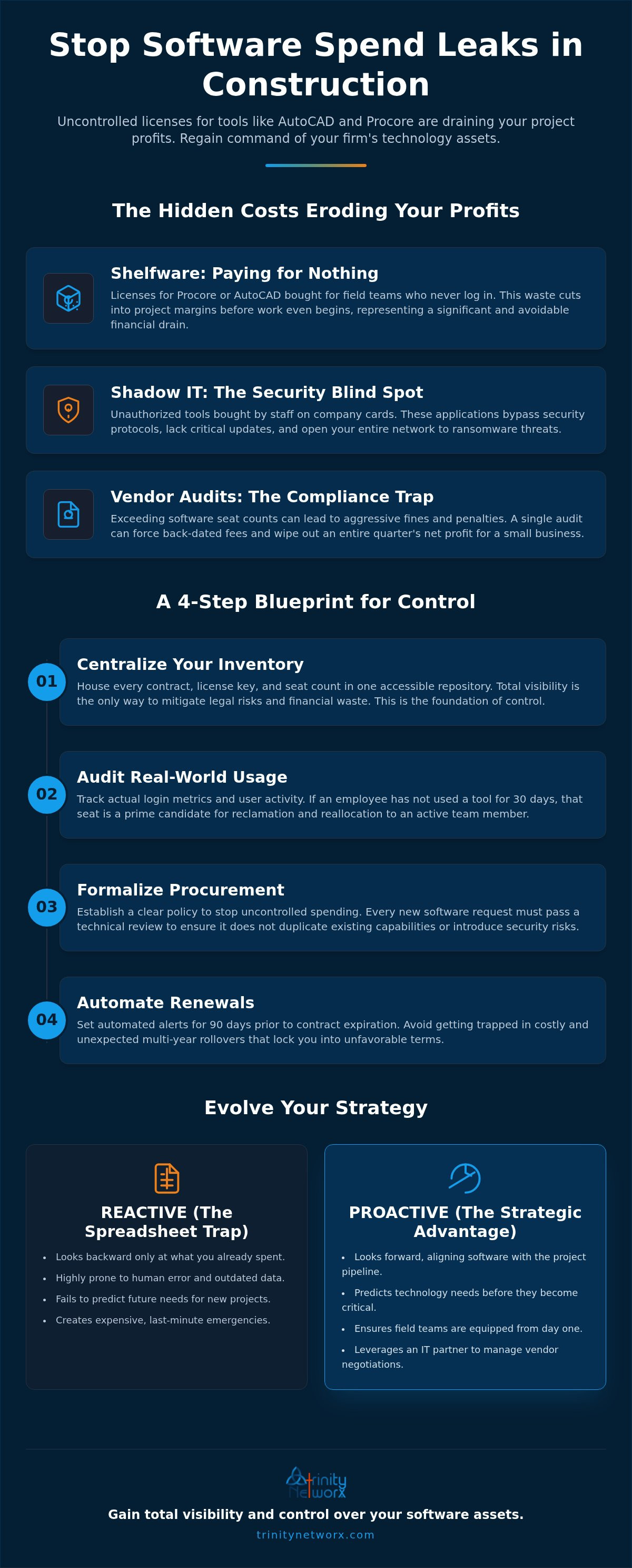
Your AutoCAD and Procore subscriptions are likely leaking more cash than a faulty site drainage system. Most construction owners accept "shelfware" as a standard cost of business. They pay for unused seats while dreading the next vendor audit. With Microsoft 365 price increases hitting in July 2026, the cost of ignored subscriptions is rising. Proactive software license management for small business turns this overhead into a strategic advantage. You deserve total visibility into who is using which tools across every job site.
We understand the anxiety of sudden compliance penalties or service gaps that stall field production. This guide provides the blueprint to eliminate wasted spend and set up automated renewal alerts. You will learn how to align your technical assets with actual field operations to drive higher project profit. We will break down the specific strategies for 2026 that keep your firm compliant and your overhead low.
• Stop paying for licenses that field crews never open. Reclaim your capital by identifying and eliminating shelfware from your project budget.
• Effective software license management for small business starts with a centralized repository for every contract and key. Total visibility prevents missed renewals and failed audits.
• Differentiate between essential construction tools and redundant subscriptions by auditing actual usage metrics. Cut monthly overhead by matching seats to active users.
• Move past basic spreadsheets by integrating software planning into your project pipeline. A proactive technology alignment process predicts future needs before they become expensive emergencies.
Software license management for small business is the proactive oversight of every digital entitlement and usage metric within your firm. It ensures you only pay for what you actually use. Many construction companies rely on a Software License Manager to track these assets, yet thousands of dollars still bleed out through shelfware. These are the seats for Procore or AutoCAD that you purchased for field teams who never actually logged in. This waste erodes project profit margins before the first shovel hits the dirt. With Microsoft 365 prices set to rise in July 2026, the cost of ignored subscriptions will only compound.
Shadow IT presents an even greater risk. When superintendents purchase unauthorized tools on company cards to solve immediate site problems, they create massive security gaps. These tools bypass your standard cybersecurity and antivirus protocols. Unmanaged software often lacks critical patches, leaving your entire network vulnerable to ransomware. It's a liability that turns a simple project tool into a back door for attackers. Our technology alignment process identifies these rogue applications before they compromise your data.
Major vendors use audits as a primary revenue recovery tool. They target small firms that lack strict oversight. If you exceed seat counts on specialized technical software, the fines are immediate and aggressive. You will be forced to pay back-dated maintenance fees and full retail prices for every unlicensed user found. A single software audit can instantly wipe out the net profit of an entire quarter for an SMB, proving why software license management for small business is a financial necessity.
Regaining control over your software spend requires more than just a spreadsheet. Effective software license management for small business starts with a centralized repository. You must house every contract, license key, and seat count in one accessible location. According to an authoritative industry perspective, centralized tracking is the only way to mitigate legal risks and financial waste. Once your data is unified, audit your actual usage metrics. If a user hasn't logged into a tool for 30 days, that seat is a candidate for reclamation.
Establish a formal procurement policy immediately. This stops employees from adding recurring costs without oversight. Every new software request must pass through a technical review to ensure it doesn't duplicate existing tools. Finally, automate your renewal alerts. Don't let multi-year contract rollovers catch you off guard; set notifications for 90 days prior to expiration. If you're struggling to track these moving parts, our team can help you build a proactive management strategy.
Construction firms face unique hurdles with floating licenses for CAD and BIM applications. Unlike standard SaaS, these tools often permit a set number of concurrent users rather than individual accounts. Tracking these requires specialized technical expertise to ensure your team isn't locked out during a critical design phase. Managing project management seats during office to field transitions is also vital. Effective software license management for small business ensures your software and workflows remain productive. If you don't track these transitions, you'll end up paying for field seats that remain inactive while your office team hits user caps.
Stop treating software as a static expense. Software license management for small business works best when integrated into a broader proactive maintenance framework. Reactive tracking only looks backward at what you already spent. A strategic technology alignment process looks forward. By employing virtual CIO services, you can predict software needs based on your project pipeline. This ensures your field teams have the tools they need before they set foot on a new job site.
Your managed IT provider should act as your primary vendor liaison. We handle the complex contract negotiations and technical requirements that often bury internal staff in paperwork. This professional oversight, often bolstered by performance monitoring solutions like Northcraft Analytics, prevents hidden fees. It ensures your licenses match your actual operational scale. We verify every entitlement against your current workforce to keep your overhead lean and predictable. This assertive approach protects your bottom line from vendor overreach.
A flat-fee IT model changes the dynamic between you and your technology partner. Because we operate on a fixed monthly cost, we are financially incentivized to reduce your software waste and prevent technical friction. Having a local SoCal partner manage these relationships means we understand the specific regional challenges and vendor landscape your firm faces every day. Software efficiency acts as a direct catalyst for sustainable business growth by reclaiming capital for high-yield construction equipment and talent acquisition.
Ignoring your subscription counts is a luxury your project margins can't afford. Effective software license management for small business stops the drain of shelfware and protects you from aggressive vendor audits. By centralizing your inventory and aligning technical assets with your project pipeline, you turn IT from a cost center into a strategic driver of growth. You need a partner who understands the specific demands of specialized construction technology like CAD and BIM. It's time to stop the financial leak.
Trinity Networx, LLC provides specialized construction IT expertise backed by a 20-minute response time guarantee. Our flat-fee all-inclusive pricing ensures your software costs remain stable and predictable. Stop overpaying for software and secure your construction firm today. Take control of your digital environment and build a more profitable future for your business.
A software license traditionally grants a perpetual right to use a specific version of a program for a one-time fee. A subscription requires a recurring monthly or annual payment to maintain access to the service and its latest updates. Most construction tools now follow the subscription model. This shift makes software license management for small business critical because you must track recurring costs instead of static assets.
This transition to subscription models is happening across all sectors, from construction to finance; for instance, tax preparers seeking modern subscription-based platforms can visit Apex Tax Solutions LLC to see how professional software is evolving.
Tracking field usage requires monitoring the login activity within your project management and CAD platforms. You can also deploy mobile device management tools to see which applications are active on company-issued tablets and phones. This data identifies underused seats that you can reclaim. It ensures your field connectivity remains high without paying for ghost users who never open the tools you provide.
Buying a standalone management tool often adds another layer of complexity that small teams don't have the time to oversee. For many firms, software license management for small business is more effectively handled through a managed IT partner. This expert oversight is part of a flat-fee service. This approach eliminates the need for extra software while ensuring your entitlements and usage stay aligned with your budget.
Failing an audit triggers immediate financial penalties. These often include paying full retail price for every missing license plus years of back-dated maintenance fees. Vendors may also charge for the cost of the audit itself. Beyond the direct costs, your firm faces a massive administrative burden. This pulls your leadership away from active job sites to handle legal disputes and forced procurement.

Article by
Lance Reichenberger, Ph.D.., J.D. (Candidate)
Dr. Lance Reichenberger is the founder of Trinity Networx, a Southern California technology firm specializing in managed IT services, cybersecurity, network infrastructure, and business technology strategy. With nearly four decades of experience in the IT industry, he works with businesses to improve operational efficiency, strengthen security, and align technology with long-term growth objectives.
Lance focuses on proactive IT management, enterprise wireless infrastructure, cybersecurity integration, and scalable technology solutions for growing organizations throughout Southern California.
The content published on this website is provided for general informational and educational purposes only. Articles may be created, edited, or enhanced with the assistance of artificial intelligence and automation tools under the direction and review of Trinity Networx. While every effort is made to ensure accuracy and relevance, the information provided should not be considered professional, legal, financial, cybersecurity, or technical advice specific to your organization. Businesses should consult directly with a qualified professional regarding their unique environment, compliance requirements, and operational needs. Trinity Networx makes no warranties regarding completeness, reliability, or applicability of the information contained within these articles.
Schedule a brief conversation with Trinity Networx to discuss your business technology needs.
Get a practical roadmap built around your business, your users, your systems, and the technology issues that need attention first.
Put the right technology, support, security, and infrastructure in place so your business can grow, adapt, and move forward with confidence.