3281 E. Guasti Rd, STE 700, Ontario, CA 91761
1712 9th Ave SW, Watertown, SD 57201
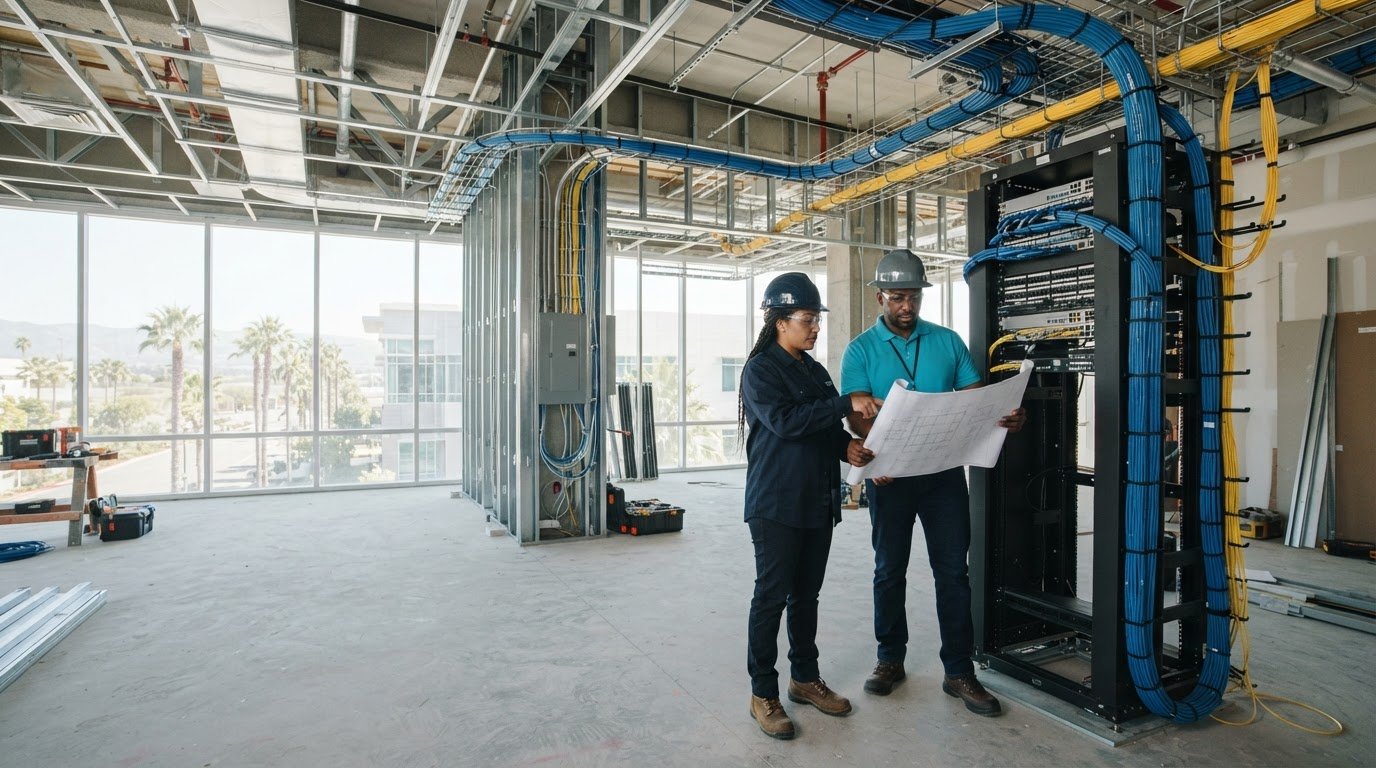
Cutting into fresh sheetrock to rerun network lines is an expensive mistake you can prevent. During fast-paced tenant improvements, mismanaging structured cabling for new office construction in Irvine triggers five-figure change orders, blown trade schedules, and failed municipal inspections before furniture arrives. You already know the operational friction that happens when uncoordinated low-voltage runs clash with high-voltage conduit or mechanical ducting right before sheetrock crews show up.
This checklist gives you a direct technical roadmap to plan, inspect, and deploy high-performance cabling without construction delays or drywall rework. You will learn the exact rough-in specifications, pathway clearances, and Fluke certification standards required to pass City of Irvine building department inspections and launch operations without punch-list hang-ups.
• Lock down pathway layouts and independent J-hook spacing before sheetrock installation to prevent trade collisions with mechanical systems and high-voltage conduit.
• Deploying compliant structured cabling for new office construction in Irvine requires CMP-rated plenum jackets and Cat6A lines to satisfy municipal building codes and fire safety standards.
• Maintain strict cable twist ratios during patch panel punch-downs to eliminate near-end crosstalk and protect ten-gigabit transmission speeds.
• Require calibrated Fluke certification reports and verified as-built drawings to secure immediate building department sign-offs and avoid punch-list holdbacks at tenant handover.
Commercial tenant improvements move quickly once framing inspects. You have a narrow window to set pathways before drywall closes the stud cavities. Deploying structured cabling for new office construction in Irvine requires total alignment with architectural prints to confirm drop counts, floor box locations, and wall cutouts before sheetrock crews begin hanging boards.
• Map every drop to confirmed architectural furniture plans to avoid abandoned runs behind fixed millwork.
• Install dedicated conduit stub-ups with protective plastic bushings to prevent cable jacket tearing on light-gauge steel studs.
• Pull CMP-rated Cat6A runs to workstation locations, presentation displays, and wireless access point locations based on a standardized structured cabling architecture.
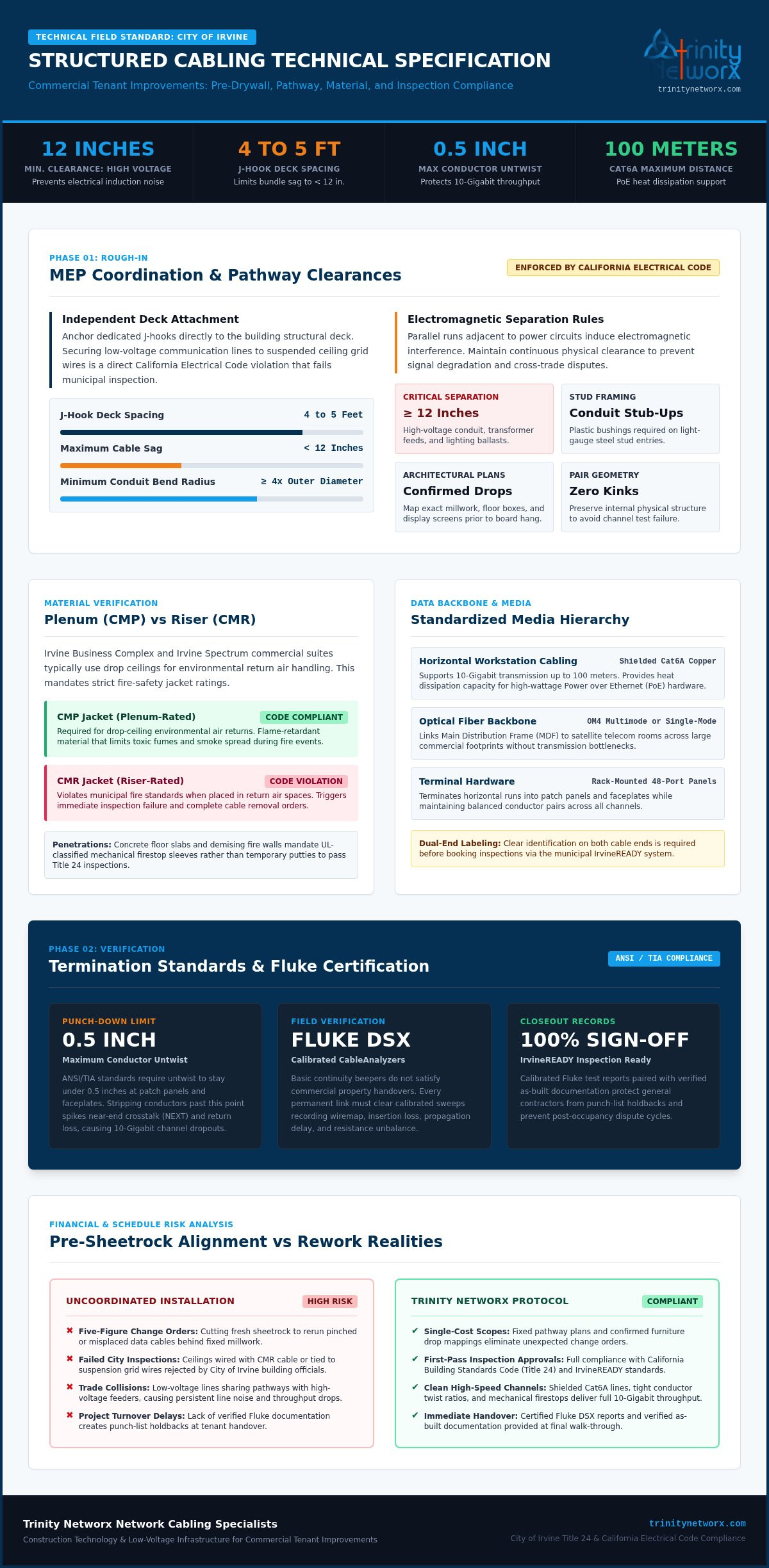
Uncoordinated trade work causes structural code failures and persistent electromagnetic noise. Under California Electrical Code requirements enforced by City of Irvine inspectors, technicians cannot fasten communication cables to suspended ceiling support wires. You must anchor dedicated J-hooks directly to the building deck, spacing supports 4 to 5 feet apart to limit cable sag to under 12 inches.
Maintain at least 12 inches of physical clearance between data lines and high-voltage conduit, transformer feeds, and lighting ballasts. Parallel runs without adequate separation induce electrical noise that disrupts network throughput. Keep conduit bend radii at four times the outside cable diameter or greater. Kinking high-performance copper ruins internal pair geometry, leading to channel test failures. Proper pre-sheetrock planning for infrastructure network cabling eliminates these cross-trade disputes before inspections occur.
Most commercial buildings across the Irvine Spectrum and Irvine Business Complex use drop-ceiling returns for environmental air handling. That construction style triggers strict material standards. You must pull Communications Multipurpose Plenum (CMP) jacketed cable throughout these open cavities. Pulling CMR riser cable into an environmental air return violates fire standards, fails rough-in inspections, and forces complete cable removal.
High-density office layouts require substantial bandwidth. Shielded Cat6A copper supports 10-Gigabit transmission up to 100 meters while dissipating heat generated by high-wattage Power over Ethernet hardware. When connecting the main distribution frame to satellite telecom rooms, link them with OM4 multimode or single-mode optical fiber backbones. This backbone infrastructure keeps data moving across large commercial footprints without transmission bottlenecks.
Local municipal inspectors enforce strict Title 24 compliance based on the California Building Standards Code. Every penetration through concrete floor slabs and rated demising walls requires UL-classified mechanical firestop sleeves rather than temporary putties. Mechanical sleeves maintain required fire ratings while letting teams add future cabling without damaging wall assemblies.
Label all cable bundles clearly at both ends before scheduling city officials through the IrvineREADY portal. Clean labeling speeds inspection sign-offs and keeps commercial timelines on track. Coordinating your project with experienced Trinity Networx network cabling specialists ensures your installation meets municipal codes under single-cost scopes with no surprise change orders. If you need dedicated low-voltage coordination for upcoming builds, contact our team to review your construction schedule.
Precision punching matters as much as careful pulling. During final fit-out, technicians terminate horizontal runs into rack-mounted 48-port patch panels and workstation faceplates. Maintaining tight pair geometry is critical. ANSI/TIA standards enforce a maximum conductor pair untwist of 0.5 inches at every punch-down point. Stripping back jacket pairs past this limit spikes near-end crosstalk and return loss, instantly degrading channel throughput.
Simple continuity beepers do not satisfy commercial property handovers. Verifying structured cabling for new office construction in Irvine demands calibrated field instruments like Fluke DSX CableAnalyzers. Every permanent link must clear full sweeps recording insertion loss, wiremap, propagation delay, and resistance unbalance. Passing tests ensure full 10-Gigabit performance across the link, protecting general contractors from post-occupancy disputes.
Inside the main equipment room, cable pathways require meticulous arrangement. Technicians dress patch cords using horizontal and vertical managers adhering to BICSI installation standards. Clean routing prevents tangled spans, avoids heavy cable strain on modular jacks, and preserves front-to-back chassis airflow around switches.
The closeout package seals project delivery. Property managers and commercial tenants need verifiable records before signing off on final retention payments. Handover deliverables must include:
• Exported LinkWare PDF test sheets showing pass results for copper and optical attenuation.
• Updated architectural as-built drawings detailing labeled drop locations across the floor plate.
• Complete rack elevation diagrams matching physical port patch assignments.
If you are planning an upcoming commercial buildout or corporate move, coordinate technology relocations by connecting with the team at Trinity Networx.
Executing structured cabling for new office construction in Irvine demands strict discipline before the first drywall screw goes in. Coordinating dedicated pathways away from high-voltage conduit protects signal integrity. Installing CMP-rated Cat6A runs satisfies California fire standards. Verifying links with field analyzers guarantees zero operational delays on day one.
With over 30 years of collective IT infrastructure expertise, our local team keeps your project moving forward without friction. We deliver single-cost project proposals with zero hidden change orders and provide Fluke certification reports for 100 percent of completed drops. Ready to lock down your pathway design and rough-in schedule? Schedule a construction low-voltage consultation with Trinity Networx today and keep your commercial handover running on time.
Cat6 operates up to 250 MHz and reaches 10 Gbps speeds only up to 55 meters under favorable conditions. Cat6A operates up to 500 MHz and guarantees 10 Gbps over the full 100-meter channel. Cat6A provides better heat dissipation in dense bundles powering modern Power over Ethernet hardware and enterprise wireless access points.
Commercial facilities across Irvine frequently use drop ceilings as return-air plenums for environmental air handling. The California Electrical Code mandates Communications Multipurpose Plenum jacketed cabling in these cavities. CMP jackets resist flame spread and produce minimal smoke toxicity during a fire. Running non-plenum riser cable in these spaces causes immediate building inspection failures.
Technicians must arrive during the MEP rough-in stage right after framing, electrical conduit, and ductwork go in. Installing structured cabling for new office construction in Irvine before insulation and drywall ensures technicians can anchor J-hooks to the building deck, maintain required separation from high-voltage conduit, and verify all drops against architectural plans.
High-voltage electricians focus on power delivery rather than high-frequency signal integrity. Exceeding 25 pounds of pull tension or untwisting pairs more than a half-inch causes return loss and crosstalk failures on high-speed copper lines. Specialized data technicians deliver certified field testing and complete as-built documentation. You can consult with Trinity Networx for project planning.

Article by
Lance Reichenberger, Ph.D.., J.D. (Candidate)
Dr. Lance Reichenberger is the founder of Trinity Networx, a Southern California technology firm specializing in managed IT services, cybersecurity, network infrastructure, and business technology strategy. With nearly four decades of experience in the IT industry, he works with businesses to improve operational efficiency, strengthen security, and align technology with long-term growth objectives.
Lance focuses on proactive IT management, enterprise wireless infrastructure, cybersecurity integration, and scalable technology solutions for growing organizations throughout Southern California.
The content published on this website is provided for general informational and educational purposes only. Articles may be created, edited, or enhanced with the assistance of artificial intelligence and automation tools under the direction and review of Trinity Networx. While every effort is made to ensure accuracy and relevance, the information provided should not be considered professional, legal, financial, cybersecurity, or technical advice specific to your organization. Businesses should consult directly with a qualified professional regarding their unique environment, compliance requirements, and operational needs. Trinity Networx makes no warranties regarding completeness, reliability, or applicability of the information contained within these articles.
Schedule a brief conversation with Trinity Networx to discuss your business technology needs.
Get a practical roadmap built around your business, your users, your systems, and the technology issues that need attention first.
Put the right technology, support, security, and infrastructure in place so your business can grow, adapt, and move forward with confidence.