3281 E. Guasti Rd, STE 700, Ontario, CA 91761
1712 9th Ave SW, Watertown, SD 57201

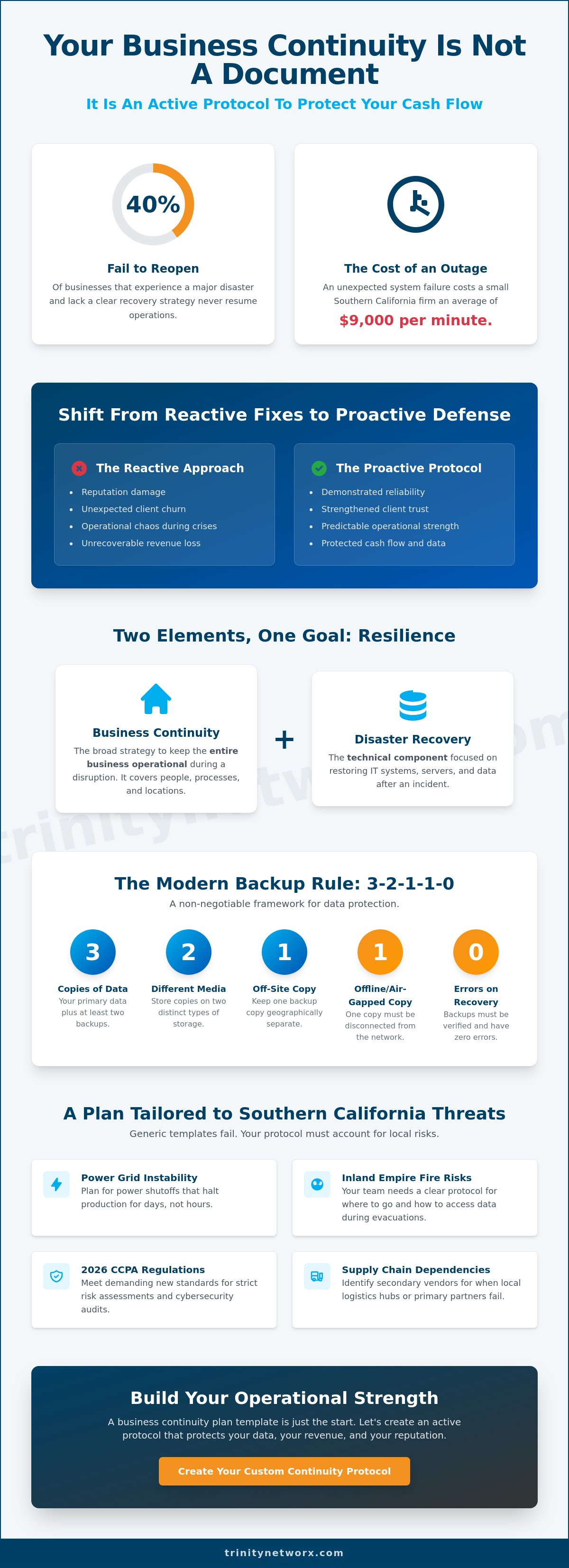
Did you know that 40% of businesses failing to reopen after a major disaster lack a clear recovery strategy? In the fast-paced Southern California market, an unexpected outage costs small firms about $9,000 per minute. You can't afford to guess when systems fail. Our business continuity plan template offers a direct path to keeping your doors open and your Inland Empire supply chain moving. It's about moving past technical jargon and focusing on what matters: your bottom line. We focus on active protocols that protect your cash flow.
You already know that clients expect your data to be safe and your services to be available. The pressure to prove resilience is higher than ever, especially with 2026 CCPA regulations demanding strict risk assessments. We promise to help you build a framework that shields your revenue from the chaos of outages. We'll explore the updated 3-2-1-1-0 backup rule and the specific steps required to meet California's latest cybersecurity audit standards. This isn't a static document; it's your guide to operational strength. You will gain the confidence to tell your partners that your data is secure regardless of the situation.
• Stop treating recovery strategies as static documents. Build active protocols that keep Inland Empire operations moving.
• Use a business continuity plan template to pinpoint profit-driving processes and the specific personnel required for instant recovery.
• Define your maximum tolerable data loss and downtime to protect your reputation before a crisis hits.
• Create a response team tailored to the unique threats facing Southern California businesses in 2026.
• Shift from reactive fixes to proactive IT management that keeps your data safe and your team productive.
Business continuity is the specific ability to maintain vital functions during and after a disaster. It is not a suggestion. It is a requirement for survival. Many leaders treat a business continuity plan template as a simple file to satisfy an auditor. They fill it out once and let it gather dust; this static approach is a major mistake. Real security comes from an active operational protocol that your team lives by every day. You need a strategy that moves as fast as your business does.
Generic templates fail because they ignore the reality of your specific location. They don't account for the Southern California power grid or the specific fire risks in the Inland Empire. If you are based in Riverside or San Bernardino, a generic document won't help when a power shutoff stops your production for three days. You need a protocol that dictates exactly where your team goes and how they access data. If your plan doesn't reflect these local threats, it won't protect your revenue when the heat rises. Business continuity planning is about keeping the engine running when the environment turns hostile.
Waiting for a crisis to plan is a recipe for failure. While technical outages are expensive, the damage to your reputation often outlasts the downtime itself. If you can't deliver when a client needs you, they'll find someone who can. Proactive planning prevents this churn. It turns a potential disaster into a demonstration of your reliability. You don't want to calculate the cost of failure while your servers are dark. Reputation damage is hard to quantify but easy to see. When a manufacturer goes dark, clients notice immediately. They don't care about the technical reasons for the delay; they care about their own lost time.
Disaster recovery is the technical restoration of your IT systems. It's about getting the servers back online. Continuity is the broader strategy to keep the whole business moving. These two elements must work in tandem for success. You can have your data back, but if your staff doesn't know where to sit or how to answer the phones, you aren't operational. We help you bridge this gap through expert IT management that focuses on the health of your entire organization. True resilience requires proactive testing and regular updates to stay ahead of shifting risks.
Stability isn't an accident. It's the result of identifying which parts of your operation actually keep the lights on. A business continuity plan template serves as your blueprint for this identification. You don't need a thousand-page manual. You need a clear list of the vital processes that generate your revenue or satisfy your legal duties. If a process doesn't do one of those two things, it isn't a priority during the first 48 hours of a crisis. You must focus your energy where it protects your bottom line.
Ranking your workflows is the first step toward actual resilience. You have to be honest about which departments can wait and which cannot. An effective BIA identifies the exact moment an outage turns from an inconvenience into a permanent failure. For many Southern California firms, this point arrives much faster than they expect. While FEMA's Ready.gov continuity plan provides a broad starting point, your specific analysis must focus on your local cash flow. If your billing system goes dark, how many days until you run out of operating capital? That number dictates your recovery speed.
Once you know what to save, you must know what tools you need to save it. Modern operations depend on a specific IT infrastructure that supports remote access and secure data flow. You need to list every piece of hardware and software required for a skeleton crew to function. Don't forget your dependencies. If you are based in the Inland Empire, your supply chain likely relies on local logistics hubs. If those hubs fail or your vendors go silent, your delivery timelines will collapse. You must have a secondary list of vendors ready to go if your primary partners fail to deliver during a disruption.
Identify your single points of failure now. This includes indispensable personnel. If your lead engineer is the only person with the admin passwords, your plan is already broken. You need redundancy in your staff and your systems. We can help you audit these vulnerabilities before they become disasters. True stability requires knowing exactly who is in charge when the primary office is inaccessible. List these names, their backups, and their contact methods in your business continuity plan template. This clarity keeps your team focused while others are panicking. It ensures your reputation stays intact when the pressure is highest.
Vague goals like "recovering quickly" lead to expensive failures. You need hard numbers to protect your operations. When you use a business continuity plan template, you must define your Recovery Time Objective (RTO) and Recovery Point Objective (RPO). These are not just technical terms. They are the financial boundaries of your survival. If you don't set these targets, your IT team will guess. Guessing results in either overspending on unnecessary speed or losing everything during a crash. You cannot manage what you do not measure.
The Business Continuity Institute (BCI) emphasizes that these objectives must align with your actual business needs. Your clients won't care about your technical excuses. They care about their own deadlines. If your Service Level Agreements promise high availability, your recovery metrics must back that up. Every minute of deviation is a threat to your reputation and your contract status. We make sure your technical capabilities match your executive promises.
Your RTO is the maximum duration of an outage you can tolerate. Be honest about your survival window. A one hour recovery for your email system might be five times more expensive than a 24 hour window. Do you really need it that fast? Maybe. If you are a high volume logistics firm in Ontario, a dead dispatch system stops every truck. That costs money immediately. Considering the average SMB loses $9,000 per minute during IT downtime, an incorrect RTO target is a massive financial liability. Categorize your departments by their immediate impact on cash flow. This keeps your costs manageable while ensuring your most vital functions stay alive.
RPO focuses on the amount of data loss you can survive. It is the point in time you go back to when restoring. If you only run a daily backup at midnight, a failure at 11 PM results in 23 hours of lost work. For many firms, that is a catastrophe. Your business data backup strategy must match your RPO goals. If you can't afford to lose more than an hour of data, you need real time replication. High stakes industries like medical manufacturing or finance can't settle for yesterday's numbers. Modern 2026 standards require more than just copies. You need automated backup verification to ensure there are zero errors when you hit the restore button. Use your business continuity plan template to map out these data needs for every critical system. It ensures your recovery is not just fast, but accurate.
Building a protocol requires action, not just documentation. You can't just download a business continuity plan template and walk away. You need a team that represents every department. They know where the secrets are and which systems are actually fragile. By gathering leaders from IT, finance, and operations, you ensure that no blind spots remain. This group must own the response when things go sideways. Their combined knowledge turns a static file into a living strategy. It forces every department to look at their own dependencies and prepare for the worst.
Inland Empire businesses face specific geographic risks. Wildfires and Public Safety Power Shutoffs (PSPS) are real. You must rank these threats by their likelihood and their impact. Ransomware is also a major player. 44% of organizations identify it as their top threat to continuity. Don't waste time on unlikely events. Focus on what is most likely to hit your facility next week. A local flood or a seismic event requires different steps than a data breach. Your procedures must be specific to these scenarios, and you can learn more about how professional roofing assessments protect your physical facility from environmental hazards. Assessing these risks allows you to allocate your budget where it will actually save your operations.
Chaos thrives in silence. You need a clear chain of command. Who calls the staff? Who emails the clients? Draft these messages now. Having a single spokesperson prevents conflicting stories from leaking. Use a primary and a secondary method to reach your team. If the cell towers are congested, do you have an alternative? Trust is built through transparency during a crisis. If you wait until the servers are smoking to write an email to your board, you've already lost their confidence. A clear communication plan keeps your reputation intact even when your systems are down.
An untested plan is just a list of wishes. You have to break things to see if your recovery works. Schedule tabletop exercises every quarter. These mock disasters reveal gaps that no document can predict. Testing ensures your team knows their roles without looking at a manual. You can also explore Disaster Recovery as a Service (DRaaS) to automate your testing and recovery steps. Automation removes human error from the equation. If you want to verify your readiness before the next storm hits, talk to our experts today. We'll help you turn that business continuity plan template into a shield for your revenue. Regular maintenance accounts for new staff and new technology, keeping your defense sharp.
A business continuity plan template is a foundation. It is not a finished shield. Many executives believe that signing a document completes their duty to the company. This is false. Real safety requires shifting from manual, paper-based planning to active management. Your recovery strategy must be alive. It needs to evolve as your network grows and as new threats emerge in the Southern California landscape. Static files don't stop outages; active protocols do.
Resilience works best when it is invisible. It should be a part of every daily task your team performs. When IT management is handled with a proactive mindset, security becomes a habit. It isn't an extra step. It is the standard way you operate. This cultural shift ensures that every employee knows their role before a crisis hits. It moves your business away from reactive fire-fighting and toward a state of steady competence. You gain the freedom to grow without the constant fear of a sudden collapse.
Monitoring your systems 24/7 is a necessity. Human error and hardware failures don't follow a schedule. Proactive monitoring catches the small glitches that precede a total system crash. This allows for fixes to happen before your staff even notices a problem. We provide a 20 minute response guarantee because we know that time is your most expensive resource. During a disruption, you need experts who are already familiar with your specific infrastructure. This reduces the burden on your internal team. They can stay focused on serving your clients while the technical heavy lifting is handled by specialists.
Action is the only cure for uncertainty. Start today by performing a high level audit of your current recovery capabilities. Be ruthless. Look for the biggest gap in your existing continuity strategy. Perhaps your backups haven't been tested in months. Maybe your communication chain is broken. Identify these flaws now while the environment is calm. Don't wait for a wildfire or a ransomware attack to expose your weaknesses. Move beyond the business continuity plan template and build a functional system that protects your revenue. Contact a professional to turn your goals into a reliable operational reality.
Operational stability is a choice made long before a crisis arrives. You have explored how a business continuity plan template evolves from a static document into an active defense. By setting clear recovery targets and training your team, you prevent the panic that destroys revenue. Resilience is about maintaining your momentum regardless of external threats. It's about protecting your cash flow and your staff. Don't wait for a local outage to reveal the gaps in your strategy.
We provide the specialized expertise required for the manufacturing and legal sectors. Our 20 minute response time guarantee and 24/7 helpdesk support ensure your systems stay available. Contact Lance Reichenberger, Ph.D. and the team at Trinity Networx, LLC to secure your business operations today. Share this guide with your leadership team to start the conversation. Use the social media share options below to help other SoCal businesses stay prepared. You have the roadmap. Now you need to move. Your growth is our goal.
The Business Impact Analysis (BIA) is the heart of your document. It ranks your processes by their financial impact so you know exactly what to recover first. Without this data, your business continuity plan template is just a stack of paper. You need to know which systems generate revenue and which can wait. This clarity ensures your limited resources go toward the functions that keep your business alive during a crisis.
You should review your strategy every quarter. Technology changes fast, and new employees join your team constantly. A plan from six months ago won't account for your latest cloud migration or office expansion. Regular updates ensure your defense stays sharp and reflects your current infrastructure. It's about maintaining a state of readiness rather than checking a box once a year.
Your cybersecurity response should be a part of your broader strategy. 44% of organizations identify cyber threats as their biggest risk to operations. While you need specific steps for ransomware, these must align with your overall recovery goals. Keeping them separate creates confusion during a real crisis. An integrated approach ensures your IT team and your executives are speaking the same language when a breach occurs.
Yes, proof of a managed recovery strategy often leads to lower cyber insurance costs. Insurers want to see that you have active protocols to minimize their payout. Showing a functional business continuity plan template proves you are a lower risk. It turns your safety measures into a direct financial benefit. You aren't just buying protection; you're proving your stability to the market.
RTO measures the clock, while RPO measures the data. RTO is the maximum time you can stay offline before the business fails. RPO is the maximum amount of work you can afford to lose. If your RPO is one hour, you must back up your data at least every sixty minutes. These numbers dictate the cost and speed of your recovery systems.
Responsibility starts at the executive level. While IT handles the technical restoration, the CEO or COO must drive the strategy. A cross-functional team ensures that every department's needs are met. This prevents the plan from becoming a purely technical exercise that ignores operational realities. You need a leader who understands the relationship between technical efficiency and overall business health.
Tabletop exercises allow you to find gaps without pulling the plug on your servers. You gather your leaders and walk through a specific scenario, like a PSPS power outage in the Inland Empire. This identifies who knows their role and who doesn't. It builds muscle memory for your team without affecting your daily production. Testing is the only way to turn a list of wishes into a reliable protocol.
Cloud backup is only one piece of the puzzle. It saves your files, but it doesn't give your staff a way to work if your office is inaccessible. True continuity includes your phones, your software, and your people. You need a strategy that covers the entire operational flow, not just a copy of your database. A backup is a safety net, but continuity is the bridge that keeps you moving forward.

Article by
Lance Reichenberger, Ph.D.., J.D. (Candidate)
Dr. Lance Reichenberger is the founder of Trinity Networx, a Southern California technology firm specializing in managed IT services, cybersecurity, network infrastructure, and business technology strategy. With nearly four decades of experience in the IT industry, he works with businesses to improve operational efficiency, strengthen security, and align technology with long-term growth objectives.
Lance focuses on proactive IT management, enterprise wireless infrastructure, cybersecurity integration, and scalable technology solutions for growing organizations throughout Southern California.
The content published on this website is provided for general informational and educational purposes only. Articles may be created, edited, or enhanced with the assistance of artificial intelligence and automation tools under the direction and review of Trinity Networx. While every effort is made to ensure accuracy and relevance, the information provided should not be considered professional, legal, financial, cybersecurity, or technical advice specific to your organization. Businesses should consult directly with a qualified professional regarding their unique environment, compliance requirements, and operational needs. Trinity Networx makes no warranties regarding completeness, reliability, or applicability of the information contained within these articles.
Schedule a brief conversation with Trinity Networx to discuss your business technology needs.
Get a practical roadmap built around your business, your users, your systems, and the technology issues that need attention first.
Put the right technology, support, security, and infrastructure in place so your business can grow, adapt, and move forward with confidence.