3281 E. Guasti Rd, STE 700, Ontario, CA 91761
1712 9th Ave SW, Watertown, SD 57201

The cheapest IT purchase can cost more over its useful life. The purchase price is only the starting point: setup, operation, maintenance, downtime, and end-of-life value all affect the real cost. To calculate the total cost of ownership for IT, add costs across the asset’s life, then subtract any value recovered when it is retired.
This broader view helps businesses compare options beyond the initial quote. This article explains total cost of ownership, which technology purchases benefit from analysis, and how life cycle cost analysis supports the calculation. It also shows how training, transition time, security, and lost productivity can affect the result, so decisions reflect day-to-day operations as well as purchase price.
• Map costs across acquisition, operation, maintenance, disposal, and less visible demands such as staff time and downtime.
• Use life cycle cost analysis to compare IT options beyond their purchase prices.
• Test how changes in usage, support needs, and downtime affect each option’s total cost.
• Use the formula that fits the asset, including any value recovered when it reaches end of life.
Life cycle cost analysis tracks an asset’s costs from acquisition through operation, maintenance, and disposal. Hardware usually has an upfront purchase price, while software may involve licenses or recurring subscriptions. Compare each option over the same useful life.
Acquisition and ongoing costs cover buying an asset and keeping it operational throughout its useful life. For a production server, include the purchase and setup, operating expenses such as electricity and network use, and maintenance costs for repairs and support. Add indirect costs, including staff time, utilities, and downtime. Together, these items show the burden beyond the invoice.
Software and transition expenses include installing or replacing systems, licensing, subscriptions, and employee training. Hardware may require a one-time purchase, while its software may carry recurring license costs. For example, moving a production team to a new application can involve data migration, setup, training, and time spent correcting transition errors. Include every cost in the same analysis period.
An outsourced-versus-in-house comparison measures the full cost of completing the same IT work under either model. For in-house support, count staff wages, benefits, training, equipment, and allocated overhead. For outsourced support, include service fees and any internal time still needed to manage the work. Compare equivalent responsibilities over the same period; otherwise, a lower figure may simply reflect a narrower service, not lower total costs.
End-of-life and switching costs capture what happens when an asset is retired or replaced. Subtract expected resale or repurposing value for hardware, but do not assign resale value to rented cloud storage. For a cloud migration, include data transfer or egress fees, system setup, employee training, and time spent resolving compatibility issues. Decommissioning old equipment and moving data also add costs.
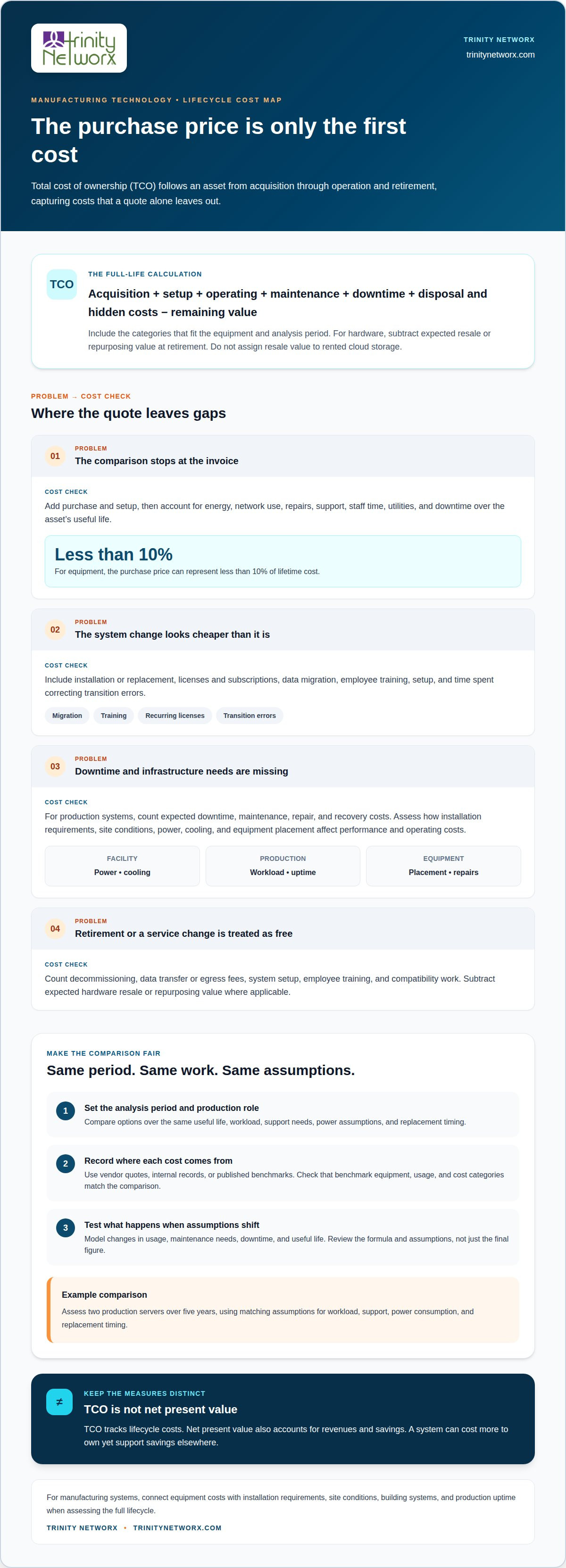
TCO analysis helps compare technology purchases whose operating demands extend beyond the initial purchase. For equipment, the purchase price can represent less than 10% of lifetime cost. That makes servers, network equipment, production systems, and software candidates for lifecycle comparison, especially when maintenance, energy consumption, or downtime may differ.
Compare alternatives over the same period and against the same work requirements. For example, assess two production servers over five years, using matching assumptions for workload, support, power consumption, and replacement timing. Industry benchmarks can provide context, but only if their equipment, usage, and cost categories match yours. Note the source of each figure, whether vendor quotes, internal records, or published benchmarks, and identify gaps before relying on the comparison.
Sensitivity analysis shows how results change when an assumption shifts. A TCO calculator can report nominal cost, present-value cost, comparisons, and sensitivity analysis. Model changes in usage, maintenance needs, downtime, or expected useful life. If one server appears cheaper only under low usage, the result shows how much the decision depends on operating conditions. Review the formula and assumptions, not just the final figure.
Use the same method to assess cloud services, software platforms, and equipment replacement. Compare recurring charges and operating demands alongside acquisition, support, and end-of-life value. A lower purchase price may not mean a lower lifecycle cost if an option requires more maintenance or staff time. For manufacturing teams, include downtime’s effect on production when comparing systems with different workloads.
If a manufacturing technology decision depends on infrastructure costs, discuss the cost factors with a technical team.
Total cost of ownership (TCO) combines an asset’s upfront purchase with costs across its useful life. A practical formula is: TCO = acquisition + setup + operating + maintenance + downtime + disposal and hidden costs − remaining value. No single formula fits every manufacturing technology purchase, so include categories relevant to the equipment and analysis period. Calculating TCO starts with defining that period and the asset’s role in production.
For a production machine, count equipment and installation, then software, energy consumption, support, repairs, and expected downtime. Add direct and indirect costs, including employee time spent training or resolving transition issues. Subtract expected resale or repurposing value at retirement. Apply the same formula to each alternative, using the same timeframe and workload. Construction technical expertise can help assess installation requirements, site conditions, and building systems that affect equipment performance and operating costs.
Manufacturing technology TCO may include recurring software or service charges based on expected use, plus costs for moving production data between systems. Add setup, administration, and costs related to transferring or managing data. Higher consumption or frequent transfers can change the total, so include them across the full analysis period. Construction specialists can assess infrastructure needs, such as power, cooling, and equipment placement, when evaluating a production system or facility upgrade.
TCO focuses on lifecycle costs, while net present value also accounts for revenues and savings. Keep the measures distinct: a system can cost more to own yet support savings elsewhere. For a manufacturing operation, compare production systems by including maintenance, downtime, and recovery costs alongside acquisition. Construction technical expertise can help identify facility or installation issues that affect uptime and repair needs. Then test how different usage levels or repair needs affect the result.
For help assessing manufacturing technology costs and facility requirements, discuss your TCO analysis.
Trinity Networx, LLC helps manufacturers connect construction technical expertise with production needs. Poorly planned facility layouts, aging building systems, or construction work that disrupts equipment access can slow production and add costs beyond the original project. Reviewing facility conditions, construction plans, and equipment requirements helps teams identify issues before work begins.
Construction technical expertise can help manufacturers assess facility upgrades, coordinate construction around production demands, and resolve building-related constraints. Turn to Trinity Networx, LLC when a facility project raises operational concerns or your team needs construction guidance for manufacturing technology environments.
Contact Trinity Networx, LLC to discuss your manufacturing facility project.
Production plans change, and technology assumptions can change with them. New workloads, data flows, or recovery priorities may affect what systems need from network infrastructure and support. Treat lifecycle costing as an ongoing planning practice, not a spreadsheet completed once and forgotten.
For manufacturing leaders, connect each technology decision to the work it must sustain, from production scheduling to equipment communication. Keep assumptions visible and revisit them when operational requirements shift. This gives future upgrade decisions a clear reference point, grounded in current business needs rather than outdated expectations.
Knowing how to calculate the total cost of ownership for IT helps teams frame those choices around business needs and timing. If you’re weighing a technology change, discuss your IT costs with Trinity Networx, LLC. Move forward with a clearer plan for your next decision.
Total cost of ownership is the full economic burden of an asset over the period a business owns or uses it. For a manufacturing site, it frames a technology choice around operational demands, not just the vendor quote. TCO gives finance and operations teams a shared basis for discussing a purchase’s business impact.
Yes, especially when teams use different assumptions. Agree on the asset’s purpose, expected usage, and analysis period before comparing estimates. A manufacturer with facilities in California, Nevada, Arizona, or Utah can separate site-specific needs, such as local operating patterns, from costs shared across the organization. Clear assumptions make comparisons easier to review.
Useful resources include your asset register, purchase records, vendor proposals, cloud usage reports, maintenance logs, and support tickets. Finance can provide spending records; IT and operations can explain workloads, recurring issues, and staff time. For a new system, gather these inputs in one worksheet and record who supplied each estimate, so later reviews can trace assumptions to their source.
TCO measures costs; it does not forecast financial return. It answers what an asset costs to own and operate, while return on investment considers benefits or savings alongside costs. For example, a production system may have a higher ownership cost but support more output. Use TCO to compare cost exposure, then assess business benefits separately.
TCO includes the expenses and internal resources required to acquire, use, maintain, and retire an asset. A useful review also captures costs missing from a supplier invoice, such as employees’ time coordinating a rollout or resolving workflow disruptions. Match the included items to the asset being evaluated, and avoid counting the same expense in multiple categories.

Article by
Lance Reichenberger, Ph.D.., J.D. (Candidate)
Dr. Lance Reichenberger is the founder of Trinity Networx, a Southern California technology firm specializing in managed IT services, cybersecurity, network infrastructure, and business technology strategy. With nearly four decades of experience in the IT industry, he works with businesses to improve operational efficiency, strengthen security, and align technology with long-term growth objectives.
Lance focuses on proactive IT management, enterprise wireless infrastructure, cybersecurity integration, and scalable technology solutions for growing organizations throughout Southern California.
The content published on this website is provided for general informational and educational purposes only. Articles may be created, edited, or enhanced with the assistance of artificial intelligence and automation tools under the direction and review of Trinity Networx. While every effort is made to ensure accuracy and relevance, the information provided should not be considered professional, legal, financial, cybersecurity, or technical advice specific to your organization. Businesses should consult directly with a qualified professional regarding their unique environment, compliance requirements, and operational needs. Trinity Networx makes no warranties regarding completeness, reliability, or applicability of the information contained within these articles.
Schedule a brief conversation with Trinity Networx to discuss your business technology needs.
Get a practical roadmap built around your business, your users, your systems, and the technology issues that need attention first.
Put the right technology, support, security, and infrastructure in place so your business can grow, adapt, and move forward with confidence.