3281 E. Guasti Rd, STE 700, Ontario, CA 91761
1712 9th Ave SW, Watertown, SD 57201

A jobsite technology problem can quickly become an office problem, too. When project software, connectivity, or field devices fail, unclear supplier responsibilities leave crews waiting and office teams without reliable information. Effective vendor management for technology suppliers gives construction firms a clear process for deciding who owns each issue and how suppliers work together.
Construction teams already know that technology suppliers are essential. The challenge is coordinating their work across the jobsite and office, then keeping service performance and renewals visible. This article explains how to set clear ownership, reduce handoff gaps, and assess supplier performance and risk. You’ll also see how construction-focused IT expertise, vendor liaison, and written network documentation can bring more structure to supplier relationships and help keep field and office operations connected.
• Map connections between jobsite connectivity, office systems, business applications, and network infrastructure to spot supplier dependencies.
• Make vendor management for technology suppliers easier to oversee by assigning an internal owner and recording each provider’s responsibilities.
• Track escalation contacts, access needs, service expectations, project changes, and review dates in one place.
• Use construction-focused IT expertise and written network records to clarify supplier handoffs. Contact the Trinity Networx, LLC team to discuss your construction technology needs.
Vendor management for technology suppliers means assigning clear ownership, expectations, and review practices across the providers that support construction work. It’s more than keeping contracts on file. Teams need to know who handles each system, where one supplier’s responsibility ends, and who coordinates the next step when a problem crosses those lines. Third-party management offers a broader definition of this supplier oversight; construction adds a practical challenge: technology must serve both active jobsites and office operations.
A network connection at a project site may support mobile access to a line-of-business application, while office staff rely on that application for project information. Cabling, Wi-Fi, cloud services, and communications may involve different providers. If a field user can’t connect, the cause could sit with the site network, the application, or the connection between them. Supplier coordination helps teams trace those dependencies and maintain a clearer path to resolving issues. It supports project continuity, but it can’t guarantee uninterrupted operations.
Construction operations may rely on internet and connectivity providers, structured cabling and Wi-Fi teams, business application vendors, cloud service providers, and communications suppliers. Field devices and office systems can depend on separate suppliers, even when workers experience them as one workflow. That’s where documented handoffs matter: teams need to identify which provider owns each component and who brings suppliers together when a fault spans several systems.
Construction-focused IT expertise can help map these connections and clarify supplier roles across jobsite and office technology. Trinity Networx, LLC describes its work with IT services for supply chain management, including vendor liaison for line-of-business applications and written network documentation. For help coordinating construction technology suppliers, contact the Trinity Networx, LLC team.
A supplier list is only useful if it shows how each provider connects to project work. Build a working record, then revisit it as site conditions and project needs change. This gives internal teams a clearer way to route issues instead of leaving field staff to decide which supplier to call.
Record jobsite connectivity, cabling, network access, business applications, cloud services, and communications. Note which systems depend on one another.
Assign one person to maintain the supplier record and coordinate issues that cross teams. The owner doesn’t need to resolve every technical fault, but should know who is responsible for the next handoff.
For each provider, record service expectations, escalation contacts, access needs, dependencies, and the work they own. Add project-specific changes, such as a new site connection or a shift in application access.
Check the record at agreed intervals and when project changes affect technology. Review response records, recurring issues, missing documentation, and any effect on field or office work.
Check whether each supplier understands site connectivity requirements, project schedules, and how field teams exchange information with the office. Confirm who handles cabling, network access, business application issues, and escalation when a fault crosses supplier boundaries. Reviews should capture what happened, who acted, and what remains unresolved, not just whether a ticket was closed.
Where responsibilities overlap across providers, IT services for supply chain management can help clarify coordination needs. Construction-focused IT planning and written network records can give teams a firmer basis for those reviews. If supplier handoffs keep disrupting project technology, talk with Trinity Networx, LLC about supplier coordination.
Bring in construction-focused IT expertise when the same fault keeps returning, suppliers disagree about who owns it, or a project change affects systems beyond the original plan. A connectivity issue, for example, may involve site Wi-Fi, network cabling, and access to a business application. Without a view of those dependencies, each provider may address only its part while the underlying handoff remains unclear.
In vendor management for technology suppliers, technical context matters as much as a contact list. A construction IT specialist can act as a vendor liaison, compare supplier responsibilities with how field and office systems connect, and use written network documentation to identify missing details. This gives the internal owner a clearer basis for assigning follow-up and recording what changed. It doesn’t guarantee that outages will stop, but it can make the cause, ownership, and next action easier to establish.
Construction IT planning connects decisions about cabling, Wi-Fi infrastructure, and connectivity to the needs of the jobsite and office. Physical network dependencies deserve particular attention: a change to cabling or equipment can affect how field users reach systems that office teams rely on. Commercial infrastructure and network cabling is one area to examine when supplier handoffs involve the physical network.
Trinity Networx, LLC works with commercial construction firms on office-to-field connectivity, low-voltage cabling, technology setup, vendor liaison, and written network records. If supplier responsibilities remain unclear or project changes expose gaps, talk with the Trinity Networx, LLC team about your construction technology needs and supplier handoffs.
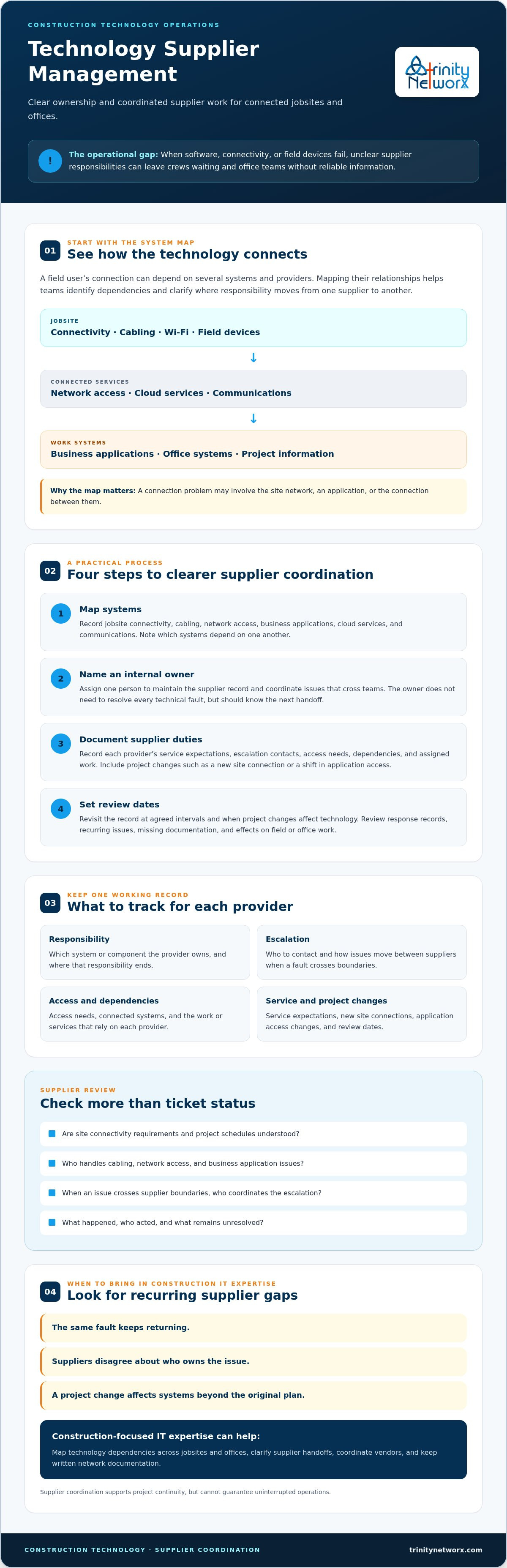
Effective vendor management for technology suppliers starts with a clear picture of how providers, systems, and project needs connect. Assign an internal owner, document supplier responsibilities, and review service records and project changes before unclear handoffs disrupt field or office work.
Construction-focused IT expertise can help close the gaps. Trinity Networx supports construction IT planning and office-to-field connectivity, coordinates with line-of-business application vendors, and provides low-voltage cabling and written network documentation. These capabilities help construction teams understand infrastructure dependencies and clarify who should take the next step when suppliers’ responsibilities overlap.
Give your team a clearer basis for coordinating technology across projects. Contact Trinity Networx to discuss construction technology and supplier coordination. With the right technical context and documented ownership, your business can move forward with greater clarity.
Vendor management for technology suppliers in construction means assigning ownership and documenting how providers support jobsite and office systems. Include connectivity, cabling, Wi-Fi, business applications, cloud services, and communications. Record each supplier’s responsibilities, escalation contacts, system dependencies, and review dates. This helps teams identify who should coordinate an issue that crosses from field technology into office operations.
Start with a shared record of systems and supplier responsibilities, then name an internal owner to coordinate issues between providers. For example, a site connectivity fault may affect access to a project application. The owner can help determine which supplier handles each part and track the handoff. Construction teams in California, Nevada, Arizona, and Utah can apply this process across active projects.
Review supplier performance on planned dates and whenever a project change affects technology responsibilities. Revisit the record after recurring outages, unresolved handoffs, or changes to site connectivity, network access, or business applications. Check response records, recurring issues, missing documentation, and the effect on field or office work. These findings help teams decide where follow-up or clearer ownership is needed.
Yes. A construction-focused IT provider can help clarify supplier handoffs by coordinating with line-of-business application vendors and documenting network dependencies. Trinity Networx supports construction IT planning, office-to-field connectivity, low-voltage cabling, and written network documentation. For construction businesses in California, Nevada, Arizona, and Utah, contact the Trinity Networx team to discuss supplier coordination.

Article by
Lance Reichenberger, Ph.D.., J.D. (Candidate)
Dr. Lance Reichenberger is the founder of Trinity Networx, a Southern California technology firm specializing in managed IT services, cybersecurity, network infrastructure, and business technology strategy. With nearly four decades of experience in the IT industry, he works with businesses to improve operational efficiency, strengthen security, and align technology with long-term growth objectives.
Lance focuses on proactive IT management, enterprise wireless infrastructure, cybersecurity integration, and scalable technology solutions for growing organizations throughout Southern California.
The content published on this website is provided for general informational and educational purposes only. Articles may be created, edited, or enhanced with the assistance of artificial intelligence and automation tools under the direction and review of Trinity Networx. While every effort is made to ensure accuracy and relevance, the information provided should not be considered professional, legal, financial, cybersecurity, or technical advice specific to your organization. Businesses should consult directly with a qualified professional regarding their unique environment, compliance requirements, and operational needs. Trinity Networx makes no warranties regarding completeness, reliability, or applicability of the information contained within these articles.
Schedule a brief conversation with Trinity Networx to discuss your business technology needs.
Get a practical roadmap built around your business, your users, your systems, and the technology issues that need attention first.
Put the right technology, support, security, and infrastructure in place so your business can grow, adapt, and move forward with confidence.