3281 E. Guasti Rd, STE 700, Ontario, CA 91761
1712 9th Ave SW, Watertown, SD 57201
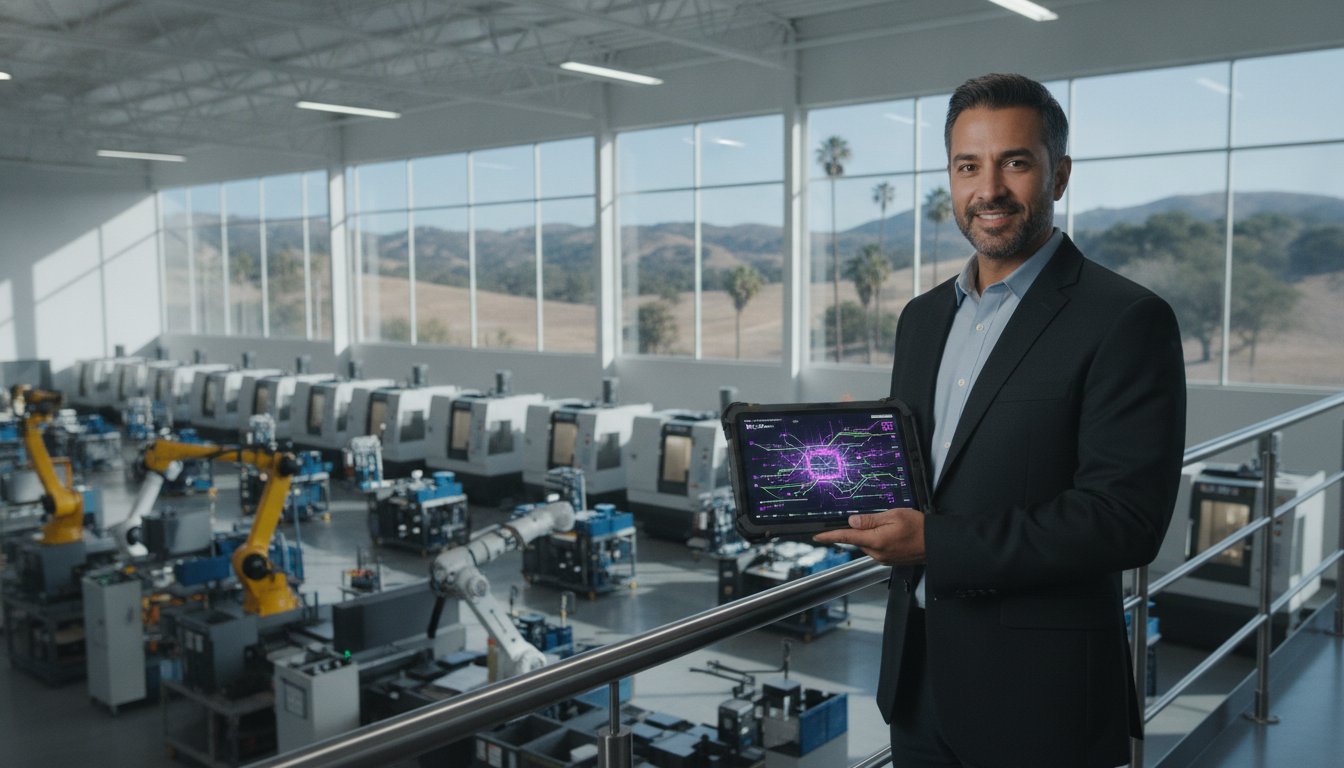
Imagine walking from the quiet front office into the roar of the assembly line only to have your critical call drop the moment you cross the threshold. You aren't alone. Many plant managers across Southern California struggle with dead zones and inaudible overhead pages that stall production. Reliable communication shouldn't stop at the office door. You need a system that holds steady. You need clarity while moving between CNC machines and loading docks.
Finding the right VoIP solutions for manufacturing plants in Orange County is about more than just making calls; it is about operational speed. This 2026 guide explores how specialized voice technology solves the specific challenges of industrial environments. You will discover how to secure clear voice quality despite heavy machinery noise. You will see how to deploy instant paging across multiple zones. We also look at how switching from legacy carriers can reduce monthly overhead by up to 50 percent. It is time to move your facility toward a more efficient, reliable future.
• Office handsets crumble in dusty, high-vibration zones. Understand how to eliminate signal dead zones caused by heavy machinery and industrial metal siding.
• Shift to ruggedized hardware with IP65 ratings to protect your equipment. Integration with multi-zone paging ensures critical alerts reach every corner of the facility instantly.
• Evaluate the benefits of cloud versus hybrid configurations. Hybrid models offer essential local survivability, keeping your phones active if your primary connection fails.
• Follow a clear deployment roadmap for VoIP solutions for manufacturing plants in Orange County. Professional site surveys and structured cabling audits prevent technical friction during the transition.
• Partner with experts who guarantee a 20-minute response time. Local support means your communication tools drive progress rather than creating bottlenecks.
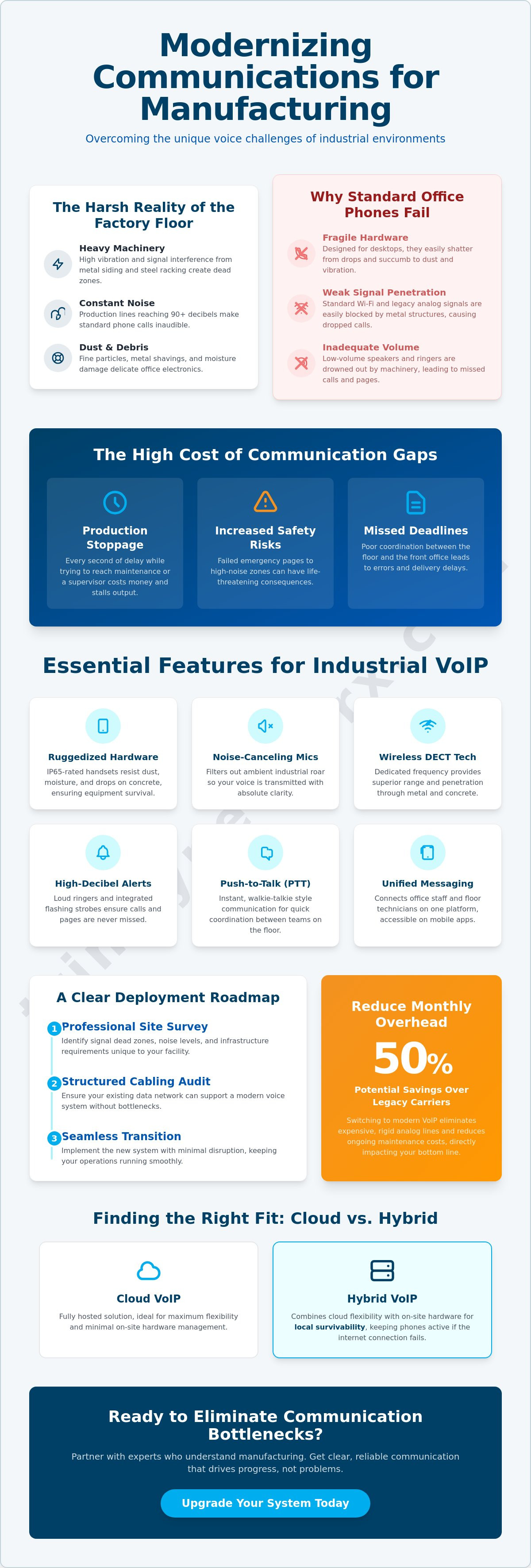
Standard office phones belong in carpeted suites. They fail when exposed to the fine dust and constant vibrations of a lathe or a stamping press. Most generic handsets shatter the moment they hit concrete. Beyond physical damage, these systems lack the volume to overcome the ninety decibel roar of active production lines. You need hardware that ignores the grit. It must speak louder than the machinery.
Signal interference is the second killer. Metal siding and dense steel racking create a maze that traps standard WiFi signals. Cheap handsets lose their connection the moment a supervisor walks behind a pallet rack. This is why generic Voice over Internet Protocol (VoIP) setups often frustrate local operators. Many local facilities find that specialized VoIP solutions for manufacturing plants in Orange County provide the only reliable way to bridge the gap between the front office and the shop floor.
When a conveyor belt jams, every second of silence costs money. If a floor supervisor cannot reach the maintenance team immediately, production stops. Communication gaps lead to missed deadlines. Safety risks follow. If an emergency page fails to reach a high-noise zone, you risk lives. Industrial VoIP is a network-based system engineered specifically for high-interference environments where standard signals die.
Many older facilities still rely on copper wiring. This legacy infrastructure is prone to corrosion, especially in the salty air common to coastal Southern California. Analog lines are rigid. Moving a workstation or reconfiguring your floor layout requires expensive technician visits for physical rewiring. Modern voice systems run on your existing data network. This shift allows your phone system to work alongside your ERP software for better data flow. Transitioning to modern VoIP solutions for manufacturing plants in Orange County eliminates the need for expensive contractor visits just to move a single desk. This flexibility is a core part of modern IT infrastructure management.
Your phone system must survive the environment it inhabits. In a machine shop, that means fighting off metal shavings, cooling mist, and the constant thrum of power tools. Generic office hardware fails here. It is fragile. It is quiet. Effective VoIP solutions for manufacturing plants in Orange County require a specialized feature set designed for the rigors of the shop floor.
Implementing the right VoIP solutions for manufacturing plants in Orange County means selecting hardware that won't quit when things get dirty. IP65-rated ruggedized handsets are the gold standard. These devices are sealed. They resist dust and moisture. They survive the inevitable drops onto concrete. Noise-canceling microphones are equally vital. They filter out ambient industrial roar so your voice carries clearly to the other end. Without these protections, you are just buying disposable equipment. For advice on these types of professional technology systems, UTD Technology Corp provides expertise in high-performance commercial solutions.
Wireless DECT phones provide the range and penetration needed for large facilities. Unlike standard WiFi handsets, DECT operates on a dedicated frequency. It moves through metal siding and heavy machinery with ease. Fixed wall-mounted stations should be placed at key checkpoints. These stations must be built to withstand physical impact and the grime of a busy shift. High-decibel alerts and flashing strobes ensure calls are noticed even when workers are wearing hearing protection.
Push-to-talk (PTT) functionality brings back the speed of the walkie-talkie. It allows for instant communication between floor teams without the friction of dialing. This keeps hands on the machines and eyes on the task. Security for these connections is paramount. Following the Cybersecurity Framework for Manufacturing ensures your voice traffic remains private and protected from external threats.
Communication silos create bottlenecks. Your office staff and floor technicians must exist on one cohesive platform. Unified messaging is a core part of effective IT management for modern plants. Mobile apps allow managers to supervise production while staying connected to client calls. They can move from the warehouse to the front office without dropping a conversation. Voicemail-to-email ensures that critical production orders are captured and shared instantly. No one has to check a blinking light on a desk phone during a shift change. If your current equipment is struggling to keep up, it is time to audit your floor communication needs to see where you are losing time.
Choosing between cloud and hybrid deployments is a strategic decision for any facility manager. Cloud systems remove the weight of on-site server maintenance. You don't need a dedicated, cooled room for a bulky PBX cabinet. Updates happen automatically. This simplicity is why many seek modern VoIP solutions for manufacturing plants in Orange County. It shifts the focus from managing hardware to using the tools to drive production. You stop paying for hardware that depreciates the moment it's bolted to the wall.
Hybrid models offer a different advantage. They provide local survivability. If a local utility crew accidentally cuts your fiber line, a pure cloud system goes silent. A hybrid setup keeps a local gateway active. Your internal extensions and emergency paging continue to function. This ensures that a localized internet outage doesn't paralyze your entire shop floor. It's about protecting your IT infrastructure from external failures you can't control. You maintain the ability to coordinate floor teams even when the outside world is cut off.
Manufacturing plants can't afford silence. When the phones go dark, orders stop moving and safety protocols weaken. Dual-WAN configurations are the first line of defense. By using two separate internet providers, your voice traffic has a failover path. If the primary connection stutters or drops packets, the system switches instantly. Proactive monitoring identifies call quality issues like jitter before they result in a dropped conversation. We don't wait for you to report a problem. We see the latency spike and act. This level of oversight keeps your communication lines as reliable as your power supply.
Legacy PBX systems are money pits. You pay for the hardware, the installation, and the expensive maintenance contracts for proprietary parts. Cloud and hybrid VoIP models move these costs to a predictable monthly subscription. You eliminate long-distance charges. You stop paying for technician visits every time you need to add a user or change a routing rule. While specific needs vary, our VoIP for small business guide provides a baseline for how these cost structures work in a modern environment. Predictability in your budget allows for better long-term planning. Implementing these VoIP solutions for manufacturing plants in Orange County turns a reactive expense into a proactive tool for growth.
Deploying a new voice system across a 100,000 square foot facility requires more than just unboxing hardware. It is a calculated deployment. Successful VoIP solutions for manufacturing plants in Orange County start with a hard look at the physical environment. You cannot guess where a signal will drop. You must know. This process ensures that when a technician picks up a handset in the furthest corner of the loading dock, the connection is immediate and clear.
Don't ignore the copper already in your walls. Evaluate your structured cabling to ensure every drop supports Power over Ethernet (PoE). This eliminates the need for individual power bricks at every station. It keeps the floor clean. It reduces points of failure. If your current wiring is outdated or damaged by years of industrial vibration, your new system will struggle regardless of the software quality. We verify the physical backbone before any hardware is mounted.
Heavy motors, electrical panels, and robotic arms generate electromagnetic interference (EMI). These forces disrupt voice packets. Physical obstacles like mezzanine levels and steel storage racks block signals. A professional RF survey identifies these weak points before you commit to a hardware layout. This survey creates a heat map of your facility, ensuring access points are placed exactly where they are needed to prevent dropped calls during floor walks.
Traffic congestion kills call quality. You must segment voice traffic using separate VLANs. This keeps your shop floor conversations isolated from heavy office data transfers or ERP syncs. Quality of Service (QoS) settings must be configured to prioritize voice packets above all else. Your it-optimization plan should track voice performance metrics to catch latency before it hits production. If a data spike occurs, your phone call shouldn't suffer.
Hardware is only half the battle. Train your team on ruggedized device handling and specific emergency paging protocols. Ensure every worker knows how to trigger a site-wide alert instantly. Transitioning to modern VoIP solutions for manufacturing plants in Orange County requires this human element to be successful. You need a team that is confident with their tools. Ready to map your facility for a better system? Contact our deployment specialists to schedule your professional site survey today.
Manufacturing in Southern California demands a partner who understands the terrain. Trinity Networx doesn't just sell software; we build the physical and digital infrastructure that keeps your floor moving. Our team handles the entire lifecycle of your system. We manage the installation of commercial structured cabling and fiber optics before we ever talk about cloud integration. This end-to-end approach ensures your VoIP solutions for manufacturing plants in Orange County are grounded in physical reality. You get direct access to vCIO consulting to align your technology with your production goals for years to come. We look at your business health, not just your dial tone.
Our methodology moves beyond the reactive "fix-it" mindset of traditional vendors. We act as a protective force for your facility. By managing the relationship between technical efficiency and operational continuity, we ensure your voice system drives progress. We don't believe in abstract descriptions or academic theories. We deliver results you can measure in reduced overhead and increased uptime. You stop being a victim of your technology and start using it as a strategic advantage.
Remote vendors often fail because they cannot perform the physical site visits required for large plant deployments. They don't see the interference from your welding stations or the signal blocks created by your mezzanine. We understand the specific challenges of the Inland Empire and OC industrial zones. Our team manages the heavy lifting of managed IT services, ensuring your network backbone is ready for high-demand voice traffic. If a cable is cut or a switch fails, we are close enough to solve it physically. You need someone who can be on-site when the situation demands it.
Downtime in a manufacturing plant is measured in thousands of dollars per hour. You cannot wait half a day for a return call from a faceless helpdesk. Our twenty minute response guarantee ensures production never stays down for long. We staff our helpdesk with local experts who know your specific network layout and floor plan. They don't waste time asking basic questions about your setup because they helped build it. They understand how your VoIP system interacts with your it-optimization goals. Ready to stop worrying about dropped calls and start focusing on your output? Contact our team for an assessment at trinitynetworx.com/contact-us to see how we can protect your operations.
Communication failure on the factory floor is a production bottleneck you can no longer afford. Rugged hardware and intelligent network design are not optional upgrades. They are essential tools for maintaining operational speed in high-noise environments. By choosing specialized VoIP solutions for manufacturing plants in Orange County, you protect your team from the frustration of dropped calls and inaudible pages. You ensure that every shift change and emergency alert happens with total clarity. Your network should support your growth, not hinder it.
Trinity Networx has served the Southern California industrial sector since 2001. We provide more than just a phone line. Our team brings deep expertise in CMMC and manufacturing compliance to every deployment. We back our work with a twenty minute response guarantee because we know every minute of downtime cuts into your bottom line. Stop struggling with legacy systems that fail when you need them most. Secure your plant communication with a professional VoIP assessment today. Your facility is ready for a system that works as hard as your machinery.
Ruggedized handsets and noise-canceling technology make VoIP perfectly viable in loud zones. These devices filter out background machinery roar so your voice remains audible. We also deploy flashing strobes and high-decibel ringers to ensure workers never miss a call while wearing hearing protection. It's about choosing the right hardware for the decibel levels of your specific floor.
Your phones stay active if you deploy a hybrid model with local survivability. This configuration allows internal calls and overhead paging to continue even without an external connection. We also recommend dual-WAN setups to provide an automatic failover path if your primary provider fails. Redundancy ensures your facility remains connected during local outages.
Porting your existing local numbers is a standard part of the transition process. We handle the coordination with your current carrier to ensure no downtime during the move. Your clients won't notice any change in how they reach your team. We manage the paperwork and the timing so the switch happens without a hitch.
You don't always need to rewire the entire plant. We perform a site audit to check if your current cabling supports Power over Ethernet (PoE). If your infrastructure is sound, we can often deploy VoIP solutions for manufacturing plants in Orange County using your existing network backbone. This avoids the cost and mess of pulling new wire through the whole building.
VoIP improves safety through instant, multi-zone paging and push-to-talk features. You can broadcast emergency alerts to specific areas or the entire facility simultaneously. This speed is critical during equipment failures or site emergencies. It turns your phone system into a proactive safety tool rather than just an office utility.
Mobile apps turn your smartphone into a full plant extension. You can take calls, check voicemails, and use the paging system from any location with a data connection. This keeps managers connected when they are visiting clients or traveling. You don't have to give out your personal cell number to stay in the loop.
A typical rollout takes between four and eight weeks from start to finish. This schedule includes the initial site survey, hardware procurement, and staff training. We manage every step to ensure the switch doesn't disrupt your active production shifts. We work around your schedule to minimize any impact on your output.
Voice packets require very little raw bandwidth. A single call typically uses about 100 Kbps of data. The real priority is Quality of Service (QoS) configuration, which ensures voice traffic moves ahead of standard data to prevent jitter. We optimize your network to handle these packets without slowing down your other business applications.

Article by
Lance Reichenberger, Ph.D.., J.D. (Candidate)
Dr. Lance Reichenberger is the founder of Trinity Networx, a Southern California technology firm specializing in managed IT services, cybersecurity, network infrastructure, and business technology strategy. With nearly four decades of experience in the IT industry, he works with businesses to improve operational efficiency, strengthen security, and align technology with long-term growth objectives.
Lance focuses on proactive IT management, enterprise wireless infrastructure, cybersecurity integration, and scalable technology solutions for growing organizations throughout Southern California.
The content published on this website is provided for general informational and educational purposes only. Articles may be created, edited, or enhanced with the assistance of artificial intelligence and automation tools under the direction and review of Trinity Networx. While every effort is made to ensure accuracy and relevance, the information provided should not be considered professional, legal, financial, cybersecurity, or technical advice specific to your organization. Businesses should consult directly with a qualified professional regarding their unique environment, compliance requirements, and operational needs. Trinity Networx makes no warranties regarding completeness, reliability, or applicability of the information contained within these articles.
Schedule a brief conversation with Trinity Networx to discuss your business technology needs.
Get a practical roadmap built around your business, your users, your systems, and the technology issues that need attention first.
Put the right technology, support, security, and infrastructure in place so your business can grow, adapt, and move forward with confidence.