3281 E. Guasti Rd, STE 700, Ontario, CA 91761
1712 9th Ave SW, Watertown, SD 57201

Lance Reichenberger, Ph.D.
Contact Trinity Networx, LLC at contact us; share this response plan on Facebook, LinkedIn, or X.
Cybersecurity failure is no longer a hypothetical risk; it is a mathematical certainty that demands a high-velocity response. When the screen locks or the database bleeds, your reaction determines if your company survives the next quarter. Understanding exactly what to do if your business is hacked prevents a temporary technical failure from becoming a permanent financial collapse. You need a partner like Trinity Networx, LLC that acts with assertive reliability rather than passive technical support.
We know the weight of unknown financial liability and the sharp fear of reputation damage. This guide provides the precise steps required to contain threats and protect your assets before the damage becomes irreversible. We will show you how to execute immediate containment, satisfy strict 2026 data breach laws, and restore your operations with professional assurance.
• Halt lateral movement by disconnecting hardware from the network the moment you detect a breach.
• Execute a precise response plan that shows you exactly what to do if your business is hacked, including capturing critical memory data for forensics.
• Navigate the legal landscape of 2026 by adhering to strict notification timelines and engaging local law enforcement.
• Harden your perimeter. Deploy Zero Trust architecture to verify every access request and secure your future operations.
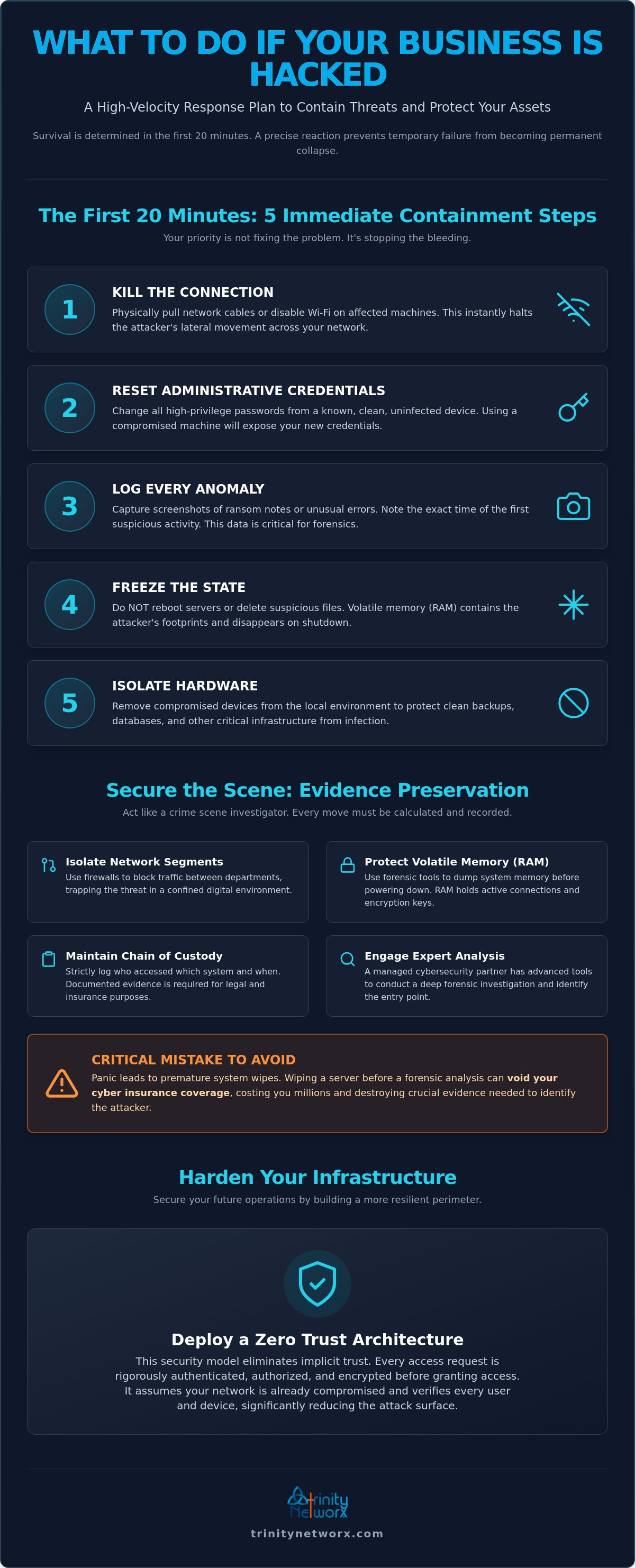
The first twenty minutes of a cyberattack determine your survival. Most small businesses wait too long, giving intruders enough time to map the entire network. If you want to know what to do if your business is hacked, the answer starts with immediate, cold-blooded containment. Your priority isn't fixing the problem yet. It's stopping the bleeding.
Physically pull the network cables or disable Wi-Fi on affected machines. This stops lateral movement, preventing the attacker from jumping from a single workstation to your primary server.
Change your passwords only from a known, clean device. If you use the infected machine to change credentials, the hacker simply captures your new keys.
Capture screenshots of ransom notes or unusual system errors. Note the exact time you noticed the first sign of trouble.
Don't reboot servers. Don't delete suspicious files. You need that data for forensics.
Remove compromised devices from the local environment to protect your backups and core databases.
Success relies on understanding data breaches and their specific entry points. You must verify if the breach started through a phishing email or an unpatched server vulnerability. Immediate isolation prevents ransomware from encrypting your entire network by trapping the malware in a dead-end segment. Once you contain the spread, trigger your emergency protocol by calling your cybersecurity and antivirus partner. Seconds matter when your data is on the line.
Corporate email is likely compromised during an attack. Stop using it for sensitive recovery discussions. Move your leadership team to a secure, out-of-band communication channel like a private messaging app or personal phones. Identify your stakeholders immediately. This group includes your legal counsel and insurance providers. They need to know the situation before it becomes public knowledge. Knowing what to do if your business is hacked means managing the message as much as the machines. Clear, quiet communication keeps the panic from spreading to your clients and staff.
Containment is more than just unplugging a machine. You need to trap the intruder. Isolate your network segments immediately to create a digital cage. This prevents the attacker from reaching your most sensitive data while your team works to neutralize the entry point. Don't reach for the power button yet. You must capture volatile memory data before it's lost during a system power cycle. RAM contains the footprints of the attacker, including active connections and decrypted encryption keys that disappear forever once the power cuts out.
Use your firewall to block all traffic between departments. Keep the threat in a confined environment.
Use forensic tools to dump system memory before shutting down any hardware.
Maintain a strict log of who accessed which system and when. Every drive image and log file must be documented to remain valid in a legal setting.
Engage a partner for managed cybersecurity services to lead the forensic investigation. They have the tools to see what your internal team might miss.
Success in these early moments dictates your long term liability. If you're wondering what to do if your business is hacked, the answer is to act like a crime scene investigator. Every move you make must be calculated and recorded. If you need immediate assistance securing your perimeter, contact our rapid response team to stabilize your network.
Panic leads to premature system wipes. This is a critical mistake. Most cyber insurance providers require a detailed forensic report before they approve a claim. If you scrub your servers before an expert sees them, you risk voiding your coverage and losing millions. Forensics is the only way to identify "patient zero." You must find the exact device or user account that served as the gateway. The FTC data breach response guide confirms that securing the evidence is a top priority for any business facing a compromise.
Don't rush back to business as usual. You must validate the integrity of your backups before you attempt a full restoration. Hackers often leave "time bombs" or dormant malware in your backup files weeks before the actual attack. Use verified data backups and disaster recovery workflows to scan for hidden threats in a sandbox environment. A simple restore just puts you back in the same vulnerable position you were in yesterday. A secure rebuild involves installing a fresh operating system and only migrating clean, raw data files to ensure the infection is truly gone.
The legal clock starts ticking the second you detect an intrusion. In 2026, regulatory patience is at an all-time low. If you're struggling with what to do if your business is hacked, your first priority must be the law. California's SB 446 mandates that you notify affected individuals within 30 calendar days. If your breach impacts more than 500 California residents, you must notify the Attorney General within 15 days of alerting consumers. Failing to meet these windows results in massive financial penalties that often eclipse the cost of the hack itself.
Ensure your timeline matches the latest 2026 updates for consumer privacy.
Coordinate with Southern California law enforcement or the FBI field offices in Los Angeles or San Diego to document the criminal act.
Prepare clear statements for your employees and clients. Honesty preserves your reputation better than silence.
Companies handling sensitive military data must consult CMMC compliance consultants immediately to protect their contracts.
Compliance isn't a suggestion; it's a survival tactic. Use the FTC's Data Breach Response Guide to align your internal steps with federal expectations. If you need an expert to audit your exposure and manage these filings, schedule a compliance consultation with our team today.
You can't notify people if you don't know what they lost. Audit your access logs to track exactly which files moved off your servers. Categorize the exposed data by sensitivity. Social Security numbers and health records require faster action than basic email lists. This audit prevents you from over-reporting and causing unnecessary panic while ensuring you meet every legal standard for high-risk data.
The rules change fast. Stay alert to federal updates regarding mandatory reporting for critical infrastructure. If your business falls under healthcare, HIPAA Breach Notification Rules require you to notify individuals within 60 days. Breaches affecting 500 or more people in medical fields must also hit the media spotlight within that same timeframe. Knowing what to do if your business is hacked means staying ahead of these overlapping deadlines to avoid compounding your losses with government fines.
Recovery isn't the finish line. It's the starting point for a higher standard of operations. If you've just learned what to do if your business is hacked, your immediate priority is closing the door you left open. Intruders often return to the same targets because they know the weaknesses better than the owners do. You must shift from a defensive crouch to an assertive, offensive posture.
• Deploy multi-layered cybersecurity and antivirus across all endpoints to catch threats at the gate.
• Implement a Zero Trust architecture. Verify every user and device request regardless of where they sit in the network.
• Schedule regular vulnerability scans. Find the holes before a hacker finds them for you.
• Transition to a proactive model. Stop incidents before they escalate into full breaches.
Waiting for an alarm to sound is a failing strategy. You need 24/7 monitoring to detect the subtle, early signs of an intrusion before the encryption begins. Proactive maintenance shrinks the attack surface by eliminating outdated software and configuration errors before they become entry points. This steady competence ensures your business health remains the priority, not just your technical survival. Moving away from the status quo means staying one step ahead of the threat actors.
Human error was a factor in 62 percent of data breaches in 2026. You can have the strongest firewalls, but a single clicked link can bypass them all. Establish recurring security awareness sessions to keep your team sharp against phishing. Knowing what to do if your business is hacked is vital, but preventing the entry is superior. For a long term view of your digital safety, read the executive guide to business data backup. It's time to act like a strategic partner in your own defense.
Recovery requires more than technical patches. It demands a shift in your operational DNA. You now understand the mechanics of isolation, the pressure of 2026 legal deadlines, and the necessity of a Zero Trust environment. This knowledge is your shield. Knowing what to do if your business is hacked turns a potential disaster into a managed incident. It ensures you don't just survive the breach but emerge with a more resilient infrastructure. You are no longer reacting in the dark. You are leading your organization back to stability with a clear, evidence-based strategy.
Trinity Networx, LLC specializes in Southern California SMBs. 20-minute response guarantee. 24/7 proactive monitoring. Expert forensic support. We stop intruders before they can take root. This is the assertive reliability your brand deserves. Don't leave your assets to chance or wait for the next vulnerability to appear. Secure your business now with Trinity Networx, LLC. You have the plan. Now get the partner to enforce it. Your future depends on the actions you take today. Move forward with confidence and strength.
Look for locked user accounts, unusual login locations in system logs, or a surge in unauthorized password reset emails. Sudden system performance drops and the appearance of mysterious new administrator accounts are definitive red flags. If your security software reports disabled features, you have a breach. Capturing these signs early is the first step in knowing what to do if your business is hacked before the damage spreads across your network.
Don't pay. Law enforcement and security experts advise against it because payment provides no guarantee of data recovery. Sixty-nine percent of ransomware victims in 2026 refused to pay. Paying only funds criminal groups and marks your organization as a soft target for future extortion. Focus your resources on secure restoration from clean backups rather than negotiating with criminals who have no incentive to help you.
Coverage depends on your specific policy and your ability to prove proactive defense. Most cyber insurance covers forensic investigations, legal fees, and notification costs. However, carriers often require documentation of tested incident response plans. If you haven't taken reasonable steps to protect your data, you risk a denied claim for the $10.22 million average US breach cost. Review your policy requirements now.
The average breach lifecycle in 2026 takes 241 days to identify and contain. Full restoration of business continuity typically requires several weeks of forensic cleaning and data verification. You can't just flip a switch. Every server must be scanned for dormant malware before going back online. Your recovery timeline relies heavily on the integrity of your offsite backups and the speed of your forensic partner.
Contact your managed IT or cybersecurity provider first. They must trigger emergency protocols to isolate the threat and preserve digital evidence for forensics. Delaying this call allows the intruder to delete logs or move deeper into your sensitive databases. Promptly engaging professional help is the most critical part of what to do if your business is hacked. Your IT partner will then coordinate with legal counsel and insurance.

Article by
Lance Reichenberger, Ph.D.., J.D. (Candidate)
Dr. Lance Reichenberger is the founder of Trinity Networx, a Southern California technology firm specializing in managed IT services, cybersecurity, network infrastructure, and business technology strategy. With nearly four decades of experience in the IT industry, he works with businesses to improve operational efficiency, strengthen security, and align technology with long-term growth objectives.
Lance focuses on proactive IT management, enterprise wireless infrastructure, cybersecurity integration, and scalable technology solutions for growing organizations throughout Southern California.
The content published on this website is provided for general informational and educational purposes only. Articles may be created, edited, or enhanced with the assistance of artificial intelligence and automation tools under the direction and review of Trinity Networx. While every effort is made to ensure accuracy and relevance, the information provided should not be considered professional, legal, financial, cybersecurity, or technical advice specific to your organization. Businesses should consult directly with a qualified professional regarding their unique environment, compliance requirements, and operational needs. Trinity Networx makes no warranties regarding completeness, reliability, or applicability of the information contained within these articles.
Schedule a brief conversation with Trinity Networx to discuss your business technology needs.
Get a practical roadmap built around your business, your users, your systems, and the technology issues that need attention first.
Put the right technology, support, security, and infrastructure in place so your business can grow, adapt, and move forward with confidence.